 Video Prompt Video102 copies
 63 copies
Video Prompt · Free video prompt
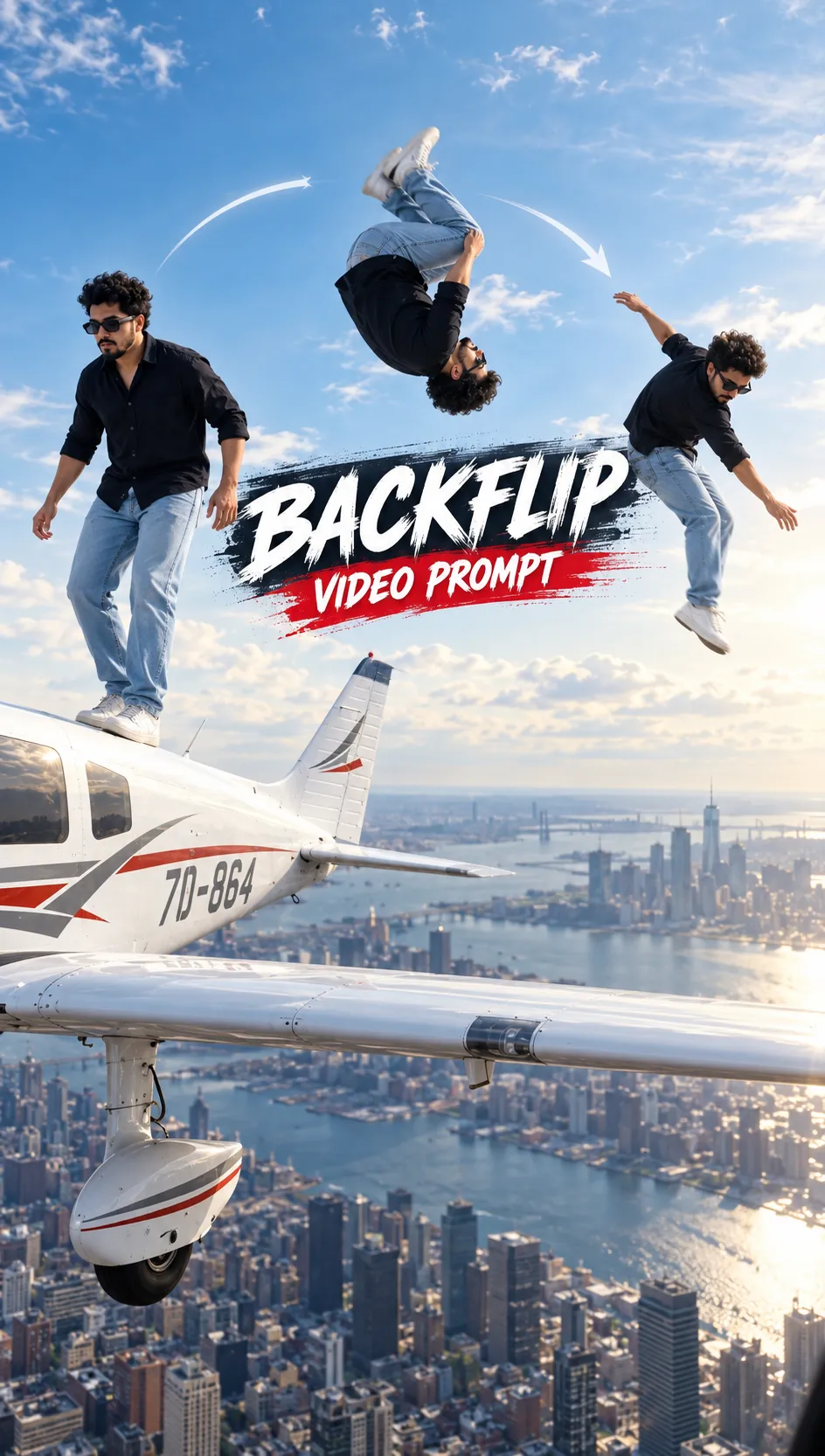
Backflip Over Plane Video Prompt
Make this look your own. Copy the full prompt and follow the guide below.
The prompt
Read the guideSeedance 2
Seedance 2.5 Video Prompt
ULTRA-REALISTIC HANDHELD SMARTPHONE FOOTAGE
Generate an ultra-realistic amateur video captured on an iPhone 16 Pro, handheld by someone traveling inside a second small aircraft positioned roughly 50 meters from the subject aircraft. The footage must convincingly resemble genuine long-distance iPhone recording, including strong HDR processing, aggressive sharpening, wide-angle distortion around the edges, deep depth of field, shadow noise, slight lens flare, subtle reflections from the aircraft window, pronounced rolling-shutter wobble, and visible atmospheric haze and heat shimmer separating the camera from the other aircraft.
SUBJECT IDENTITY — STRICT REFERENCE PRESERVATION
@image3
Treat the individual visible in @image3 as the sole and absolute identity source for the subject.
Whenever the subject appears, reproduce that person exactly according to @image3.
Never reinterpret or redesign the individual.
Never generate a substitute person.
Do not make the subject female.
Do not make the subject male.
Do not introduce or eliminate any gender-associated visual traits.
Keep the face completely unchanged.
Preserve all facial proportions exactly.
Maintain the identical skin tone.
Retain the same body proportions.
Keep the apparent age unchanged.
Preserve the exact hairstyle and hair length.
Do not create longer hair.
Do not introduce a ponytail.
Do not remove any existing hair.
Never fabricate facial characteristics.
Do not beautify the person.
Do not apply stylization.
Never alter ethnicity or nationality.
Never replace the referenced individual with another identity.
Any generic assumptions about a character must be overridden completely by the visual information in @image3.
Whenever visible, the person must look exactly like the individual shown in @image3.
Determine the subject's physical appearance exclusively from @image3.
IDENTITY MUST REMAIN CONSISTENT FOR THE FULL DURATION OF THE VIDEO.
From the opening frame through distant views, movement, inversion, landing, and the return into the aircraft, the exact same individual must remain clearly recognizable.
WARDROBE — EXACT REFERENCE MATCH
Match every piece of clothing and every accessory precisely to @image3.
Do not create additional clothing.
Do not redesign any garment.
Keep every color unchanged.
Do not introduce accessories.
Do not remove accessories.
Footwear must remain identical.
Headwear must remain identical.
Eyewear must remain identical.
The hairstyle must remain identical.
Movement must never cause an unexplained wardrobe change.
The subject's complete referenced appearance must remain unchanged throughout the sequence.
AIRCRAFT — STRICT REFERENCE MATCH
@image1
Show a white Piper PA-28 Warrior II, a single-engine, low-wing light aircraft featuring red and grey side striping, black registration lettering, fixed tricycle landing gear, and a three-blade propeller spinning fast enough to appear as a translucent blurred disc.
The paint should have slight realistic weathering, while natural sunlight creates believable glare across the windshield and fuselage.
The aircraft travels rapidly in level flight at approximately 700 meters altitude.
No other person may be visible inside this aircraft.
LOCATION — REFERENCE
@image2
The environment is New York City viewed from roughly 700 meters above ground.
Below, show Manhattan's dense street grid rushing past with pronounced horizontal motion blur, along with rooftops, water towers, and tiny yellow taxis.
Through realistic atmospheric haze, recognizable elements include One World Trade Center, the Empire State Building, Midtown skyscrapers, Central Park, the Hudson River, East River, and bridges.
Use clear skies and bright, natural midday sunlight.
MOTION — ESSENTIAL REQUIREMENT
Both aircraft must continuously travel forward at high speed.
At no moment should the subject aircraft look stationary relative to the scene.
Because both planes are moving, the subject aircraft should continually shift around within the camera frame.
Allow it to advance toward the leading edge of the shot.
The person filming briefly loses track of the aircraft.
They then make imperfect handheld panning adjustments to locate it again.
The subject aircraft returns toward the middle of the composition.
Turbulence causes it to bob and dip vertically by several meters.
Introduce subtle alternating left and right roll.
Continuously vary the apparent distance between the two aircraft from approximately 40 to 60 meters.
Everything must communicate genuine airborne motion and physical instability rather than an aircraft that appears frozen, suspended, or digitally composited.
PARALLAX — ESSENTIAL REQUIREMENT
Small fragments of cloud and thin layers of atmospheric haze rapidly cross the space separating the filming aircraft from the subject aircraft.
Tiny foreground particles and atmospheric haze streak quickly past the camera.
The nearby city directly underneath moves extremely quickly and displays heavy horizontal motion blur.
Buildings at intermediate distances travel across the view more gradually.
The far horizon shifts only extremely slowly.
These distinctly different movement speeds must establish convincing three-dimensional depth and parallax.
Keep the propeller continuously represented as a translucent rotating disc.
The aircraft vibrates throughout the entire shot.
While open, the cabin door visibly rattles, shakes, and judders under the force of the airflow.
CAMERA
Present everything as ONE SINGLE CONTINUOUS TAKE WITHOUT INTERRUPTION.
NO CUTS.
NO EDITING.
NO TRANSITIONS.
NO CAMERA-POSITION CHANGES.
NO SECOND CAMERA.
NO ORBITING MOVEMENT.
NO FLYAROUND CAMERA MOTION.
NO SWITCHING TO THE OPPOSITE SIDE.
NO MOVING CLOSER TO THE SUBJECT AIRCRAFT.
Throughout the recording, the physical camera position remains approximately 50 meters away from the subject aircraft.
Only optical or digital zoom may alter the apparent framing.
The camera operator remains physically seated inside another small aircraft.
Maintain persistent amateur handheld shaking.
Include realistic hand-induced movement.
Framing should remain imperfect.
The subject may occasionally slip out of view.
The operator repeatedly corrects the composition manually.
Whenever digital zoom is used, introduce authentic softness, compression artifacts, increased noise, and smeared fine details.
AUDIO
Capture sound as though recorded directly through an amateur smartphone microphone.
The aircraft engine is extremely loud.
Strong wind noise dominates portions of the recording.
Wind repeatedly buffets the microphone.
Occasional microphone clipping occurs naturally.
Mechanical vibration remains audible.
The person recording responds spontaneously to what they see.
At the start, their stunned voice says:
“oh my god… oh my god!”
When the aerial backflip occurs, the camera operator bursts into shocked laughter and excited shouting.
Their voice naturally cracks from surprise.
Breathing remains faintly audible beneath the engine and rushing wind.
SEQUENCE
0.0–3.0 SECONDS — WIDE VIEW
Begin with the subject aircraft appearing comparatively small within the frame.
It races forward through the air above Manhattan.
The city beneath streaks rapidly past with intense horizontal motion blur.
Since both aircraft are traveling at speed, the subject aircraft continuously wanders within the handheld composition.
Its cabin door suddenly swings open and strikes against the force of the airflow, then remains open while violently vibrating.
The camera operator reacts, making a small and imperfect corrective pan to reacquire the aircraft.
The subject starts moving toward the open cabin doorway.
3.0–6.0 SECONDS — DIGITAL ZOOM-IN
Exactly when the subject begins climbing out of the cockpit, initiate a gradual but uneven smartphone pinch-to-zoom.
The zoom must feel manually performed and imperfect.
As magnification increases, image quality becomes noticeably softer, noisier, compressed, and digitally smeared.
The subject visibly struggles against the powerful airflow.
One hand remains firmly gripping the aircraft's door frame.
The subject carefully positions both feet onto the wing.
They gradually straighten until standing on the wing.
Throughout this action, preserve the exact identity and appearance established by @image3.
6.0–8.0 SECONDS — MOVEMENT TOWARD WINGTIP
The subject lets go of the door frame.
They cautiously walk across the aircraft wing toward its outer tip.
Both arms naturally extend outward to maintain balance.
The intense airflow visibly pushes against the person's body and clothing.
Every physical action must accurately reflect aerodynamic forces and realistic human balance.
The subject advances using careful, deliberate steps.
Meanwhile, the aircraft continues racing forward.
Turbulent air causes subtle pitching, bobbing, and rolling movements.
The camera operator struggles continuously to keep the aircraft and subject properly framed.
The subject eventually reaches a position close to the wingtip.
They firmly plant both feet and prepare to jump.
8.0–9.5 SECONDS — CONTROLLED BACKFLIP
From the wing, the subject executes one controlled backward flip.
Begin the movement with a powerful upward push.
The body naturally rises above the wing.
The knees draw inward toward the chest.
The arms move organically to control rotation.
The body completes one full backward revolution.
The surrounding airflow visibly influences the subject throughout the maneuver.
Maintain a physically plausible airborne trajectory.
The rotation should be rapid yet controlled.
During every stage of inversion, preserve the exact identity shown in @image3.
NO transformation of physical appearance while inverted.
NO alteration of hairstyle.
NO wardrobe changes.
NO facial or identity morphing.
At this moment, the camera operator responds with stunned shouting and disbelieving laughter.
9.5–11.5 SECONDS — WING LANDING
The subject completes the flip and lands with both feet contacting the aircraft wing.
Give the landing realistic physical weight and impact.
The aircraft responds visibly to the force.
The wing dips.
A noticeable shudder passes through the complete airframe.
Immediately after touchdown, the subject momentarily loses balance toward the rear.
Their arms move quickly in an instinctive attempt to stabilize.
They successfully recover before falling.
The subject then lowers into a deep crouching position.
Both hands make contact with the wing surface.
The person remains securely positioned on the wing.
Briefly hold this moment while the aircraft continues its rapid forward flight.
11.5–14.0 SECONDS — RETURN INSIDE AIRCRAFT
Gradually reduce the digital zoom.
Keeping the body low against the powerful wind, the subject travels back along the wing toward the cabin.
They reach the open doorway and pull themselves inside the aircraft.
The cabin door is then closed.
Forward flight continues without interruption.
The subject becomes visible once again through the side window.
They turn their attention directly toward the camera aircraft.
The subject smiles and waves.
Their identity must still correspond exactly to the @image3 reference without any alteration.
14.0–16.0 SECONDS — AIRCRAFT DEPARTURE
Return to a broader smartphone framing.
The subject aircraft aggressively banks into a rapid right-hand turn.
Its wings visibly tilt during the maneuver.
It accelerates farther away above Manhattan.
The aircraft progressively advances ahead of the filming aircraft.
As separation increases, it becomes increasingly smaller within the frame.
The camera operator attempts to follow using handheld panning but cannot track it perfectly.
Eventually, the aircraft approaches the outer edge of the image.
The person filming continues laughing in disbelief.
PHOTOREALISM
Use authentic real-world physics.
Accurately represent aerodynamic forces.
Aircraft vibration must appear physically realistic.
Turbulence must behave naturally.
Human body movement must remain believable.
Wind interaction with the person and clothing must appear genuine.
Camera shake must resemble authentic handheld smartphone recording.
Atmospheric depth and perspective must remain realistic.
Long-distance smartphone degradation must look genuine.
Use natural midday illumination.
Use physically plausible natural shadows.
No cinematic color treatment.
No polished Hollywood aesthetic.
No artificial beauty lighting.
No CGI-looking imagery.
No videogame-like rendering.
No animated appearance.
No slow-motion footage.
No physically impossible floating.
No teleportation.
No cuts.
No scene changes or transitions.
No duplicate subject.
No duplicated aircraft.
No identity alterations.
FINAL REFERENCE PRIORITY
@image3 serves as the definitive and highest-priority visual source for the subject.
Whenever written instructions and the visual reference conflict, @image3 must take precedence.
The generated person must visually reproduce the individual in @image3 exactly.
Never determine gender based on generic wording within the prompt.
Never substitute the referenced individual with a separately generated character.
REFERENCE IMAGE = EXACT AND UNCHANGING SUBJECT IDENTITY.
No sign-up needed. You can also select and copy the text manually.
More inspiration for you
View all →




SponsoredAd
The creator's guide
How to use Backflip Over Plane Video Prompt
Use “Backflip Over Plane Video Prompt” as a starting point for your Video Prompt creation. The guide below highlights instructions from this specific prompt and shows what to change when adapting it to your own idea.
01
Get ready
Start with a clear reference photo. Upload it to an AI tool that accepts images before pasting the prompt. Choose a well-lit image with the subject unobstructed.
02
Copy & create
Copy the complete prompt above, paste it into your AI tool, and generate a first version. Keep the original instructions for your first attempt.
03
Refine one detail
Check the eyes, hands, skin texture, and likeness first. If the face changes too much, ask to preserve the reference identity and remove conflicting appearance instructions.
Inside this prompt
Lighting
Use natural midday illumination
Composition
From the opening frame through distant views, movement, inversion, landing, and the return into the aircraft, the exact same individual must remain clearly recognizable
Style
ULTRA-REALISTIC HANDHELD SMARTPHONE FOOTAGE
Three variations to try
Try one follow-up at a time after generating your first result.
Change the mood
Keep the subject and composition. Replace the lighting with soft natural window light and a calm, muted palette.
Make it your own
Keep the visual style. Replace the setting with a location of your choice and remove any details that conflict with the new scene.
Adapt the framing
Keep the face and identity consistent. Leave extra space around the head and shoulders for a square profile-picture crop.
If your result looks different
The preview is a visual reference, not a guaranteed output. Results vary by model, settings, and reference image. Keep the instructions that matter most, remove contradictions, and change one detail between attempts.