
Create cartoon of me based on our chats
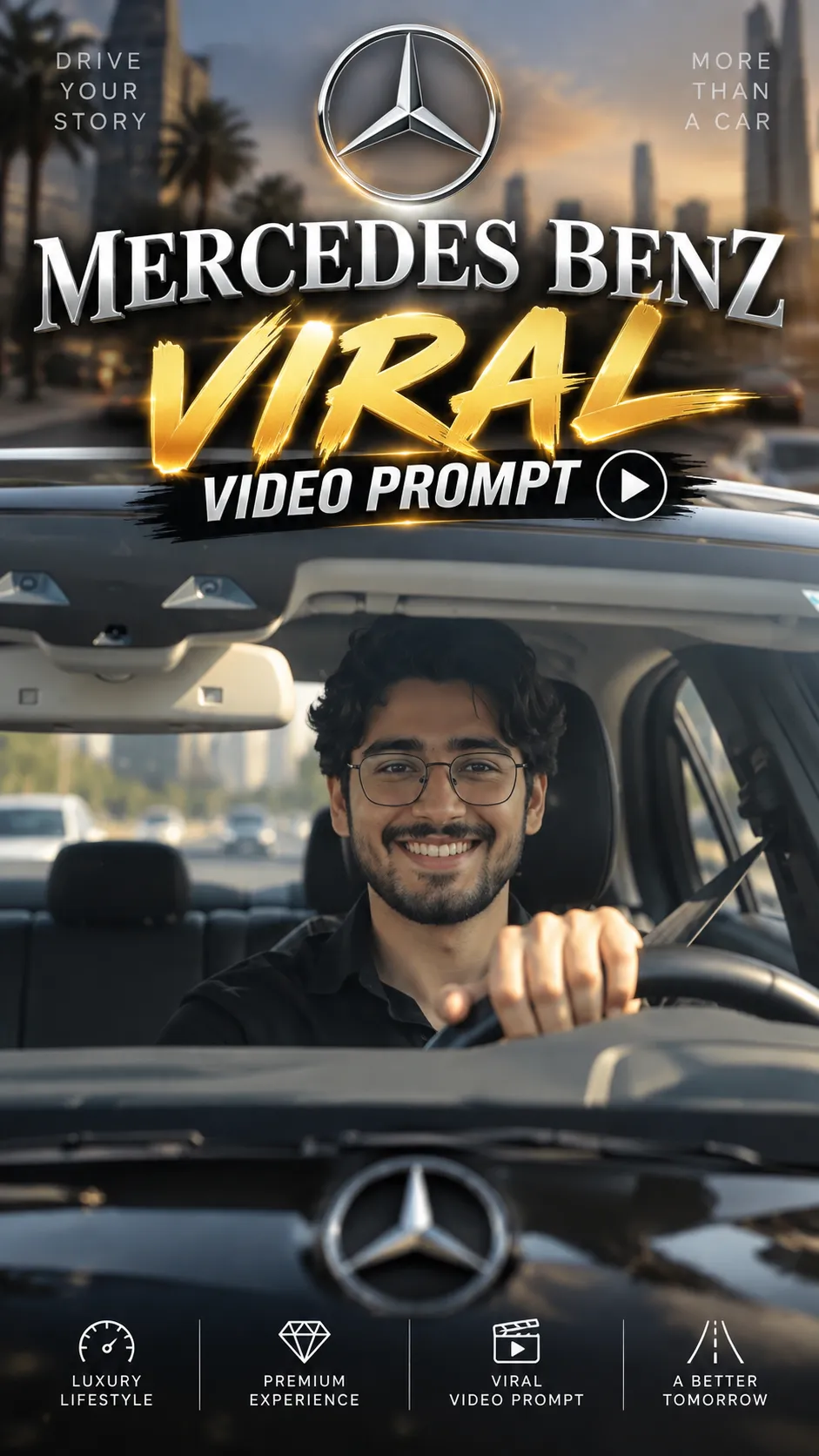
Use the uploaded reference photo for the driver’s exact face, identity, and features. Generate a 10-second, ultra-realistic video of this person driving a black Mercedes sedan during the day. Ensure natural camera optics, authentic lighting, and continuous, fluid motion without any sudden stops or a CGI look. Scene & Sequence (0.0 – 10.0s): 0.0–2.0s (Exterior Approach): Wide shot. A glossy black Mercedes-Benz sedan drives smoothly and dynamically toward the camera on a paved road in natural daylight. 2.0–4.0s (Continuous Motion & Snap Zoom): The car continues rolling forward smoothly (DO NOT stop the car). As it moves, the camera performs a rapid, seamless snap-zoom straight in through the front windshield. In a quick reaction, the driver raises an open hand to playfully cover/block their face. 4.0–7.0s (Slow-Motion Reveal): The footage seamlessly transitions into smooth slow-motion. The driver drops their hand away from their face, revealing a bright, natural, radiant smile directed right at the camera. 7.0–10.0s (Pose & Hold): Still in slow-motion, the driver casually moves their hand to rest near the back of their neck/shoulder, laughing warmly. Their head tilts slightly with a relaxed, confident expression. Key Settings: The car's movement must be continuous and fluid during the zoom—no jerky stops. Maintain authentic glass reflections, natural daylight, anatomically correct hands (5 fingers), and realistic skin texture with no artificial smoothing.
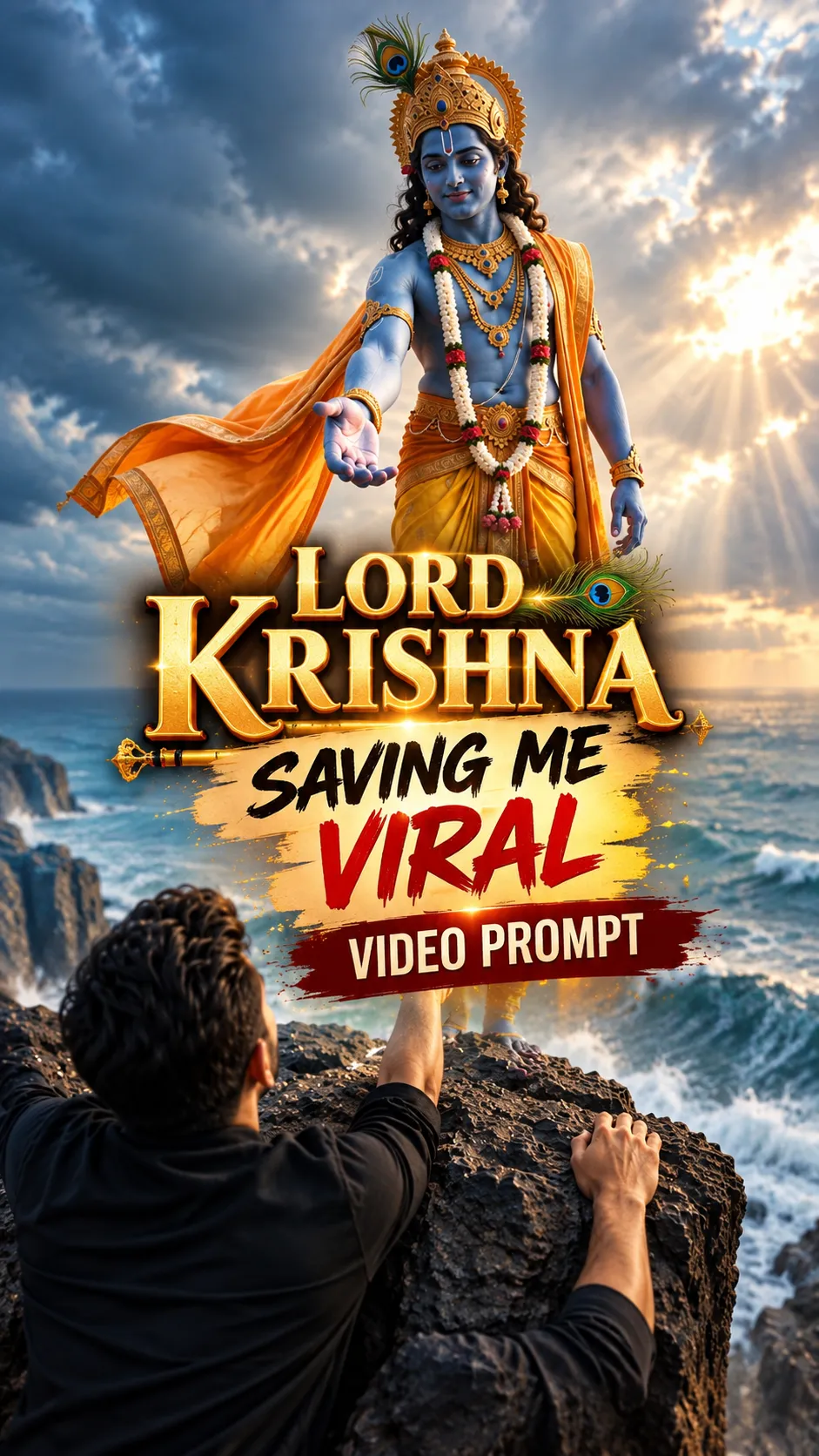
"### MASTER PROMPT — REALISTIC LORD KRISHNA DEVOTIONAL RESCUE (10 SECONDS) Create an exactly 10-second, ultra-realistic cinematic devotional video featuring an adult male based on my uploaded face photograph and Lord Krishna, generated entirely through AI. The video depicts a fictional, spiritually uplifting rescue scene in which Lord Krishna helps an adult devotee reach safety on a high rocky ocean cliff. The sequence should emphasize divine compassion, trust, hope, and emotional relief. All characters are adults. The scene is a peaceful, fictional cinematic depiction of divine assistance, with no injuries, graphic content, or harmful actions. 1. MAIN CHARACTER — FACE REFERENCE Use my uploaded photograph as the visual reference for the adult male devotee. Preserve his recognizable facial features, face shape, eyes, eyebrows, nose, lips, beard, hairstyle, complexion, and natural skin texture. Maintain a consistent facial appearance throughout the entire video without beautification, facial alterations, or identity changes. He wears a fitted black full-sleeve shirt and black pants. His hairstyle, clothing, and physical proportions remain consistent. 2. LORD KRISHNA — REALISTIC AI-GENERATED APPEARANCE Generate Lord Krishna entirely through AI. No separate Krishna reference image is required. Krishna must appear as a real, living person physically present in the environment, with naturally blue skin, realistic Indian facial features, authentic human skin texture, expressive eyes, and natural facial movements. His appearance includes long dark curly hair, an intricately designed traditional golden crown topped with a single beautiful peacock feather, traditional gold jewellery, a yellow dhoti with rich golden detailing, an orange-golden flowing dupatta, a floral garland, and traditional ornaments. His expression is peaceful, compassionate, and reassuring. His skin must have natural human texture, realistic pores, subtle highlights, and believable environmental lighting. Avoid cartoon, animation, painting, statue, or artificial CGI appearances. Maintain Krishna's exact same facial appearance, blue complexion, hairstyle, crown, jewellery, and clothing throughout the entire video. 3. ENVIRONMENT — HIGH ROCKY OCEAN CLIFF The scene takes place on a magnificent, towering black volcanic cliff overlooking an enormous ocean. The cliff rises hundreds of feet above the water, with a dramatic vertical rock face and a safe rocky platform at its summit. Powerful ocean waves crash against the distant rocks below. The atmosphere features an overcast grey-blue evening sky, soft ocean mist, wet volcanic rocks, and natural coastal wind. The environment should feel grand, peaceful, spiritual, and cinematic. IMPORTANT SCENE COMPOSITION: The adult devotee is positioned just below the upper edge of the towering cliff, holding the rocky edge with one hand while his body extends vertically along the cliff face. His other hand reaches upward toward Lord Krishna. Krishna is positioned on the safe upper rocky platform, directly above the devotee, extending his hand downward to help him reach the top. The scene must clearly establish the vertical separation between the two characters and the enormous ocean far below. This is an uplifting rescue scene, not a beach scene or a scene where both characters are sitting together. 4. SHOT 1 — 0–2 SECONDS Begin with a cinematic side-angle shot of the adult devotee holding the upper edge of the towering rocky cliff with one hand. His body extends downward along the vertical rock face, with his legs suspended away from the upper platform. The ocean is visible far below, emphasizing the extraordinary height of the landscape. He looks upward toward the summit with an emotional expression of hope and devotion. His free hand reaches upward. Use realistic human anatomy, natural body positioning, and authentic cinematic camera movement. 5. SHOT 2 — 2–4 SECONDS Transition smoothly to a low-angle cinematic shot revealing Lord Krishna positioned on the safe rocky platform above the devotee. Krishna looks downward with a peaceful, compassionate expression and gently extends his hand. His golden crown, single peacock feather, jewellery, yellow dhoti, and orange-golden fabric respond naturally to the ocean breeze. The devotee remains below the upper cliff edge, reaching upward toward Krishna. Maintain a clear difference in elevation between the two characters. 6. SHOT 3 — 4–6 SECONDS Show a cinematic close-up of the devotee's upward-reaching hand meeting Krishna's naturally blue hand. Their hands connect in a firm, supportive grip. Krishna gently assists the devotee upward toward the safe rocky platform. The devotee uses his other hand to support himself against the rocky edge. Their movements must appear natural, physically believable, and emotionally meaningful. 7. SHOT 4 — 6–8 SECONDS Transition to a cinematic side-angle shot showing Krishna helping the devotee move upward onto the safe rocky platform. The devotee's upper body rises above the cliff edge as Krishna continues supporting him. The devotee then brings his legs onto the upper platform and reaches a secure position beside Krishna. The enormous vertical cliff and distant ocean remain visible in the background. Ensure realistic body mechanics, natural hand contact, consistent character positioning, and smooth cinematic movement. 8. SHOT 5 — 8–10 SECONDS After reaching the upper rocky platform, the devotee embraces Krishna with deep gratitude and devotion. Krishna gently wraps both arms around him in a compassionate, reassuring embrace. The devotee closes his eyes, expressing relief, peace, and emotional connection. The camera slowly moves backward and slightly upward, revealing both characters embracing on the summit of the magnificent ocean cliff. The vast ocean remains visible far below. Soft natural sunlight subtly emerges through the cloudy sky, creating a peaceful and spiritually uplifting cinematic atmosphere. 9. CAMERA AND PACING The entire sequence must last exactly 10 seconds. Maintain normal human movement speed, smooth cinematic transitions, and consistent spatial positioning. Use professional cinema camera aesthetics, 35mm and 50mm lens characteristics, intimate close-ups, cinematic side-angle compositions, natural handheld movement, and controlled dolly movements. The rescue and final embrace should feel natural rather than rushed. 10. VISUAL STYLE Ultra-realistic Indian cinematic filmmaking, photorealistic human skin, natural facial expressions, physically accurate hands and fingers, realistic fabric movement, authentic ocean waves, natural wind, subtle film grain, shallow depth of field, anamorphic lens characteristics, natural motion blur, atmospheric mist, and premium movie-quality cinematography. Maintain a dark, moody, cinematic grey-blue environment with natural human skin tones. Krishna's blue skin, golden jewellery, and yellow-orange garments should remain rich, realistic, and visually prominent without excessive saturation. 11. IMPORTANT REALISM REQUIREMENTS The adult male devotee must retain the recognizable facial identity of the uploaded reference photograph throughout the video. Lord Krishna must be generated entirely through AI and maintain a consistent, realistic human appearance with naturally blue skin. The devotee must initially be positioned below the upper cliff edge, with Krishna positioned above him on the safe rocky platform. The ocean must remain visibly far below the characters. Krishna must physically assist the devotee upward onto the upper rocky platform before the final embrace. Maintain realistic anatomy, consistent clothing, natural body movements, physically believable hand contact, and authentic emotional expressions. 12. NEGATIVE PROMPT / AVOID Beach-level rescue, both characters sitting together, both characters standing at the same elevation before the rescue, shallow rocks, low-height cliff, inconsistent character positioning, cartoon Krishna, animated Krishna, 3D-rendered appearance, plastic skin, statue-like face, painting-like appearance, artificial blue skin, excessive glowing effects, identity drift, facial morphing, distorted hands, extra fingers, missing fingers, duplicated limbs, broken anatomy, inconsistent clothing, unnatural body movements, floating objects, unrealistic ocean physics, accelerated footage, random camera cuts, text, subtitles, logos, and watermarks. 13. REFERENCE SETUP Reference 1 — Uploaded Face Photograph: Use the uploaded clear photograph as the adult male devotee's facial identity reference. Preserve his recognizable facial appearance throughout the video. Reference 2 — Lord Krishna (AI Generated): No Krishna reference image is required. Generate Lord Krishna entirely through AI using the detailed character description above. Maintain his consistent realistic facial appearance, natural blue complexion, hairstyle, crown, peacock feather, jewellery, and traditional clothing throughout all five shots. FINAL OUTPUT: An exactly 10-second, ultra-realistic cinematic devotional video showing an adult devotee holding the upper edge of a towering ocean cliff, Lord Krishna extending his hand from the safe platform above, helping the devotee reach the summit, and sharing a deeply emotional embrace with him. The sequence must convey divine compassion, trust, hope, protection, and spiritual peace through realistic cinematic visuals and natural physical interactions."

Create a complete export of every memory you have stored about me, along with any personal context retained from earlier conversations. Whenever possible, keep my original wording unchanged, particularly when reproducing my instructions, preferences, or directions. Categories — present them in exactly this sequence 1. Instructions: Rules I explicitly told you to follow in future interactions, including tone, formatting, style, recurring 'always do X' or 'never do X' requirements, and corrections I made to your behavior. Include only instructions contained in stored memories; do not pull rules directly from conversation history. 2. Identity: My name, age, location, education, family information, relationships, languages, and personal interests. 3. Career: My present and previous jobs or roles, companies, and broad areas of professional skill or expertise. 4. Projects: Projects that I substantially created, developed, or committed to. Ideally, provide one entry for each distinct project. For every entry, begin with the project's name or a concise identifying description, then state what it does, its current status, and any important decisions associated with it. 5. Preferences: My general opinions, tastes, recurring preferences, and working-style preferences that apply across situations. 6. Format: Follow the formatting requirements below exactly. For every category, use a dedicated section header. Inside each section, place exactly one entry on each line and arrange entries chronologically from the oldest known date to the newest. Write each entry using this structure: [YYYY-MM-DD] - Entry content here. When an entry's date is unavailable, use: [unknown] - Entry content here. Output requirements Place the entire exported content inside one single code block so it can be copied easily. Immediately after the code block, indicate whether the export contains the complete available set or whether additional stored information still remains."
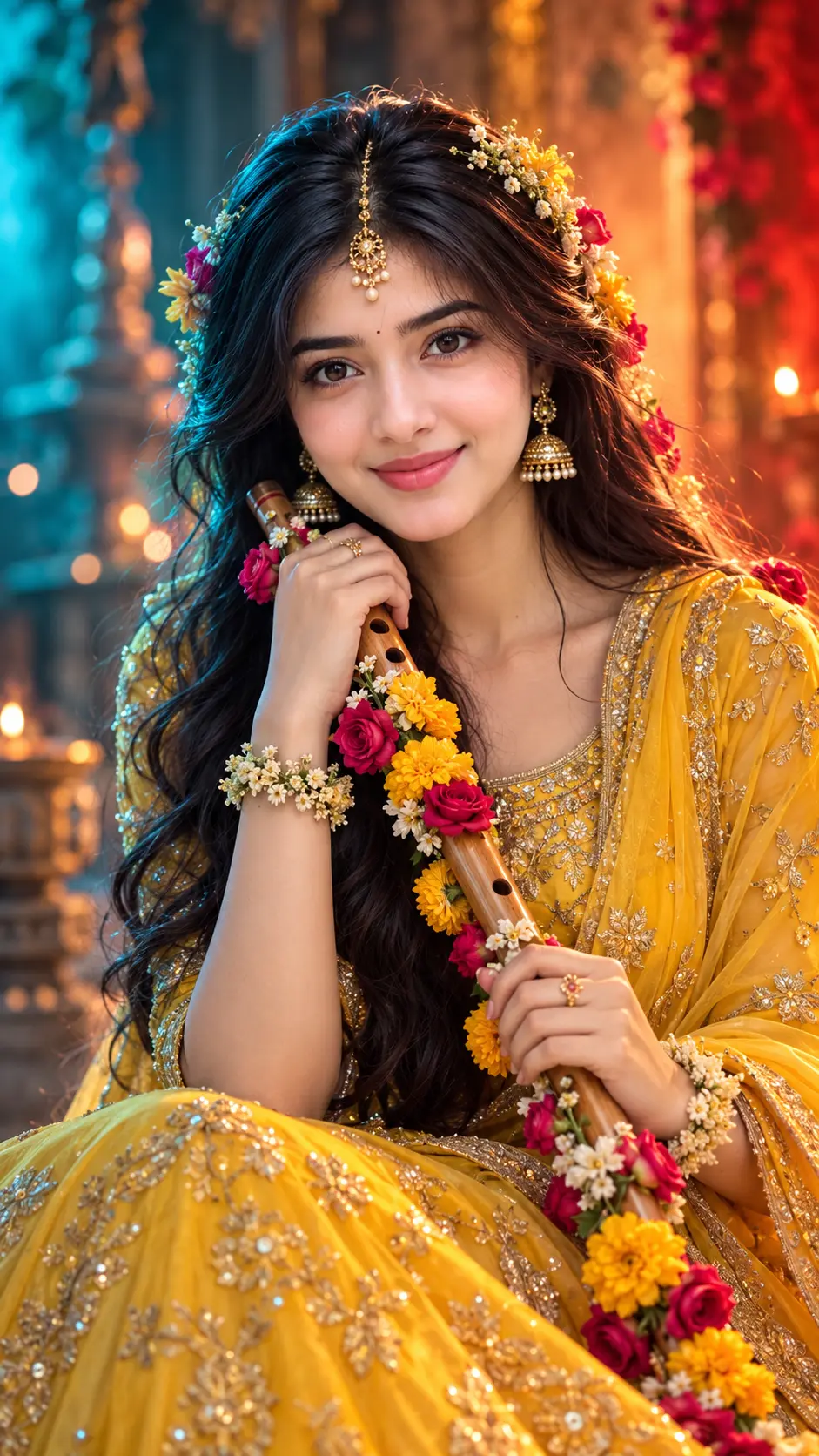
Create a high-resolution cinematic portrait of a beautiful Indian woman portrayed as Radha, dressed in a vivid yellow lehenga embellished with intricate golden embroidery. She holds a traditional wooden flute beautifully decorated with colorful marigold and rose garlands. Style her hair in soft, loose waves and adorn it with a delicate floral crown. Complete her appearance with traditional gold jewellery, including a maang tikka and jhumka earrings. Use dramatic split lighting: one side illuminated with soft cyan/teal and orange tones, while the opposite side glows with rich, warm red-orange light. Keep the background softly blurred with elegant bokeh, creating an ethereal atmosphere. Hyper-realistic details, cinematic quality, high resolution, 8K. Aspect ratio: 9:16.
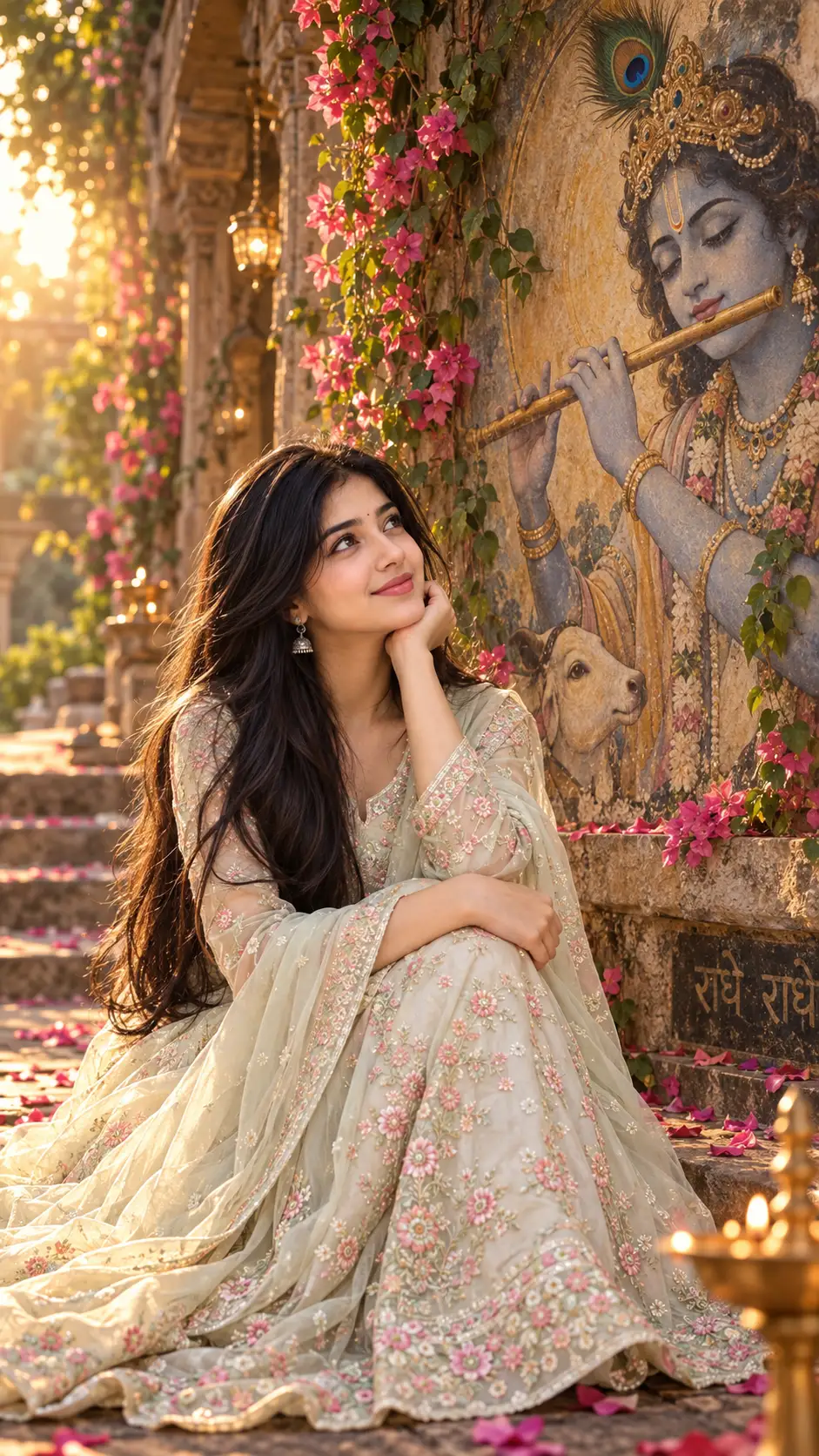
Create an ultra-realistic devotional Indian portrait of a young Indian girl seated gracefully on an aged stone pathway next to a large wall mural depicting Lord Krishna playing the flute. She gazes upward toward Krishna with a profound expression of devotion and admiration. She has long, silky black hair and wears an elegant floral cream lehenga with beautifully flowing layers, paired with a black blouse. Surround the scene with blooming pink flowers and climbing vines spreading across the wall, while the highly detailed Krishna artwork appears intricately carved into the surface. Illuminate the entire photograph with warm magical golden-hour evening light, creating cinematic shadows, a gentle soft glow, and subtle volumetric lighting while keeping her outfit consistent throughout the image. Maintain a deeply spiritual, divine, dreamy, and emotionally devotional atmosphere with rich warm tones, realistic skin texture, intricate fabric detailing, and shallow depth of field. Professional photographic composition, photorealistic, HDR, ultra-detailed, masterpiece quality, 8K resolution, vertical portrait. Aspect ratio 9:16.
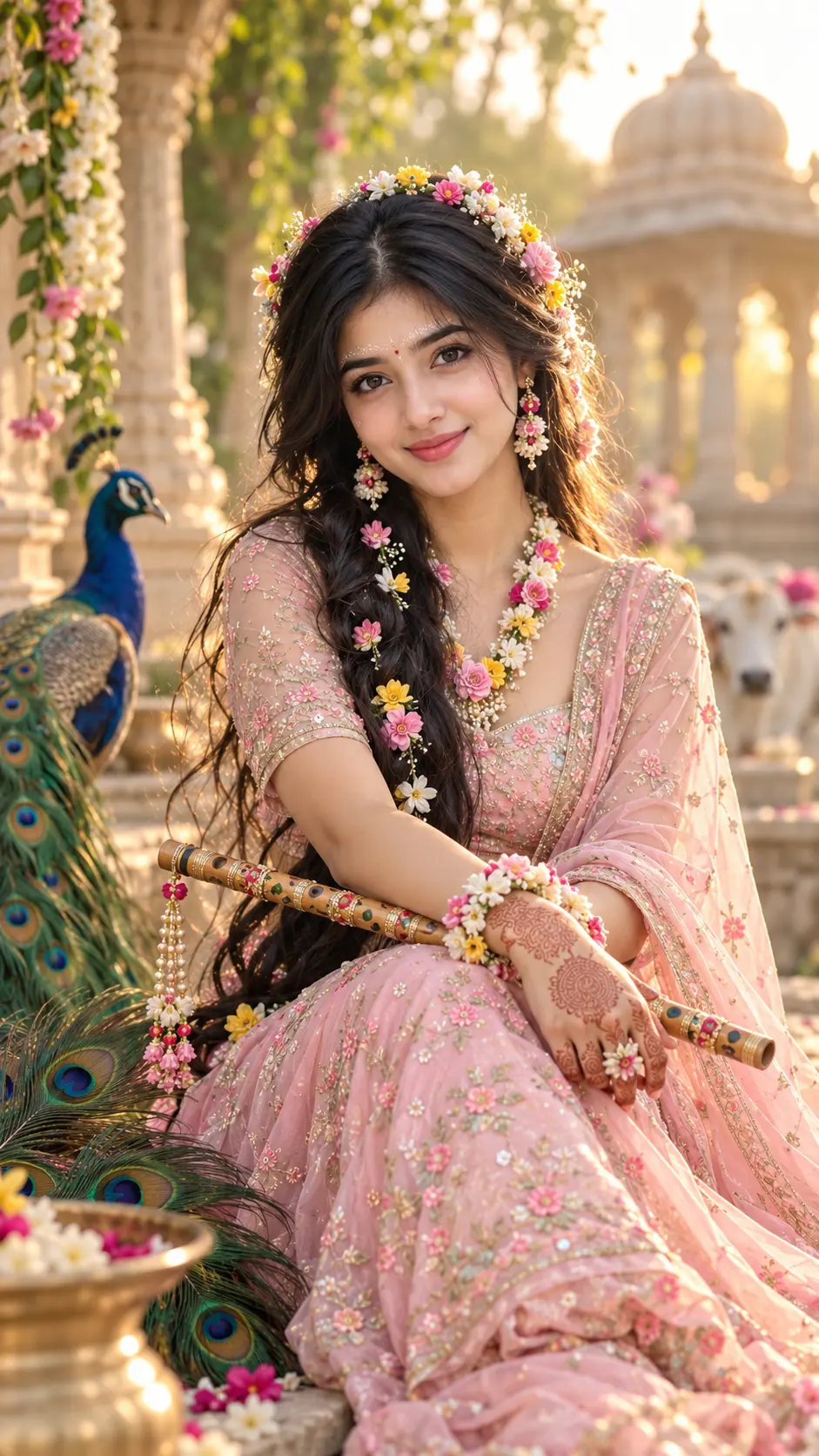
Create an ultra-photorealistic portrait of a beautiful Indian young woman styled as Radha, seated elegantly with her legs folded in a peaceful setting inspired by Vrindavan. She wears a traditional soft-pink lehenga decorated with fine, delicate embroidery. Her long, silky black hair is beautifully interwoven with fresh, colorful flowers, complemented by a floral crown of pink, yellow, and white blossoms, along with coordinated flower earrings, necklace, and hair ornaments. An intricately embellished wooden flute rests gracefully across her lap, with peacock feathers arranged around her. Both hands feature detailed mehndi designs. Give her subtle Radha-inspired makeup, including a tiny red bindi and delicate white decorative artwork across her forehead. Capture her with a gentle natural smile and a calm, devotional expression. Warm golden-hour sunlight softly illuminates her face and hair, producing a dreamy golden glow and beautiful rim lighting. In the background, show ancient temple architecture softly out of focus, maintaining a serene Vrindavan atmosphere with shallow depth of field. Use cinematic photography with warm pastel tones, vibrant yet natural colors, an ethereal devotional aesthetic, extremely detailed floral elements, and authentic realistic skin texture. Photorealistic DSLR-quality imagery, 85mm lens, f/1.8, golden rim light, hyper-realistic 8K masterpiece quality. No text, no watermark, no visual distortion, and no extra fingers. Vertical 9:16 aspect ratio.
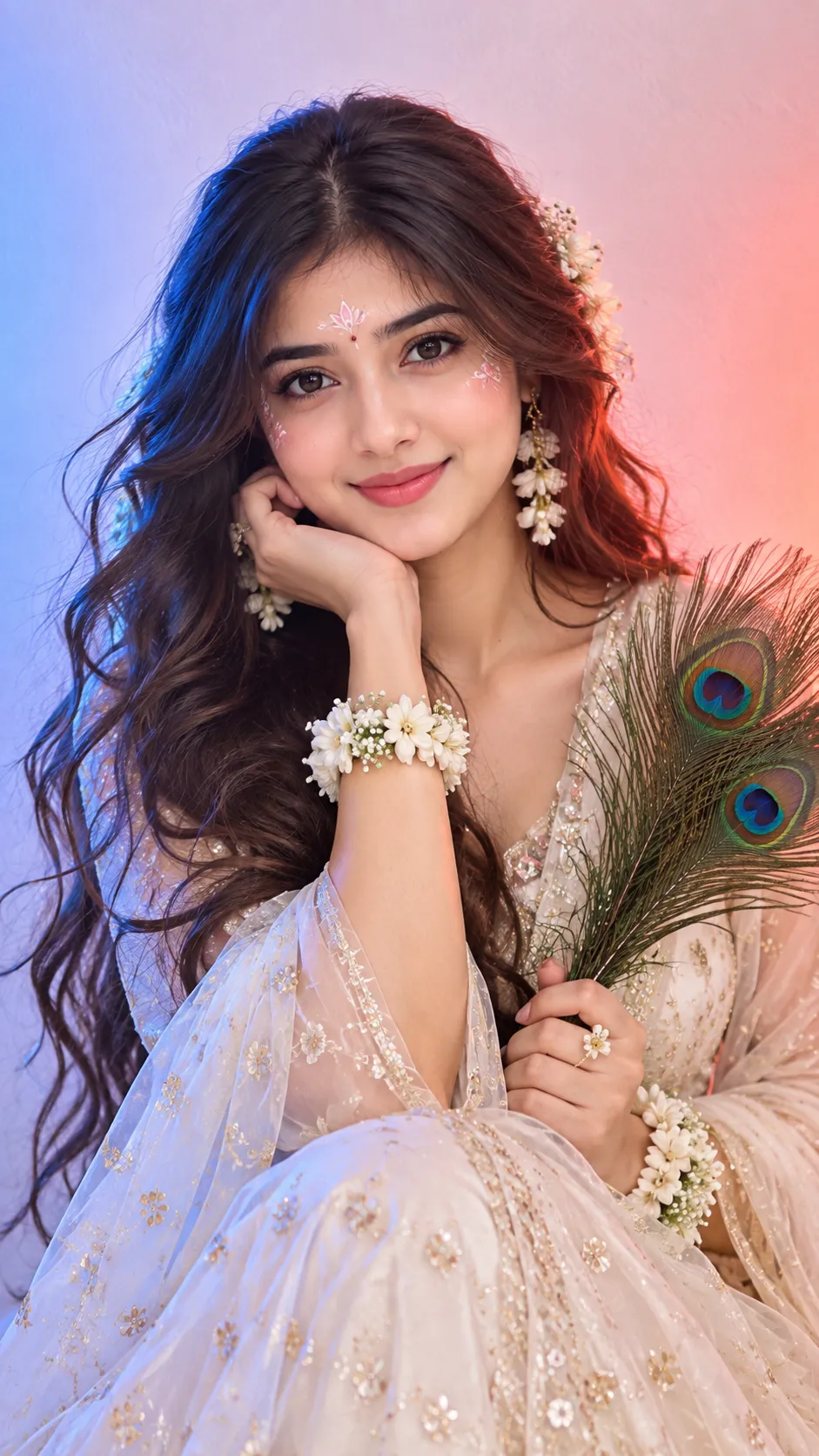
Create a vertical portrait of a young woman with a peaceful, serene expression, styled to resemble Radha. She has long, brown, wavy hair flowing naturally, with subtle and minimal mural-style artwork decorating her forehead and face. Dress her in an elegant white chiffon lehenga featuring delicate golden shimmer, paired with minimal floral jewellery. Place peacock feathers gracefully in her hand. Set the scene against a simple solid white wall with a clean, minimal background. Illuminate the portrait with a gradient blend of warm blue and warm red HD neon lighting reflecting softly across the image, producing a dreamy, cinematic atmosphere. Aspect ratio: 9:16.
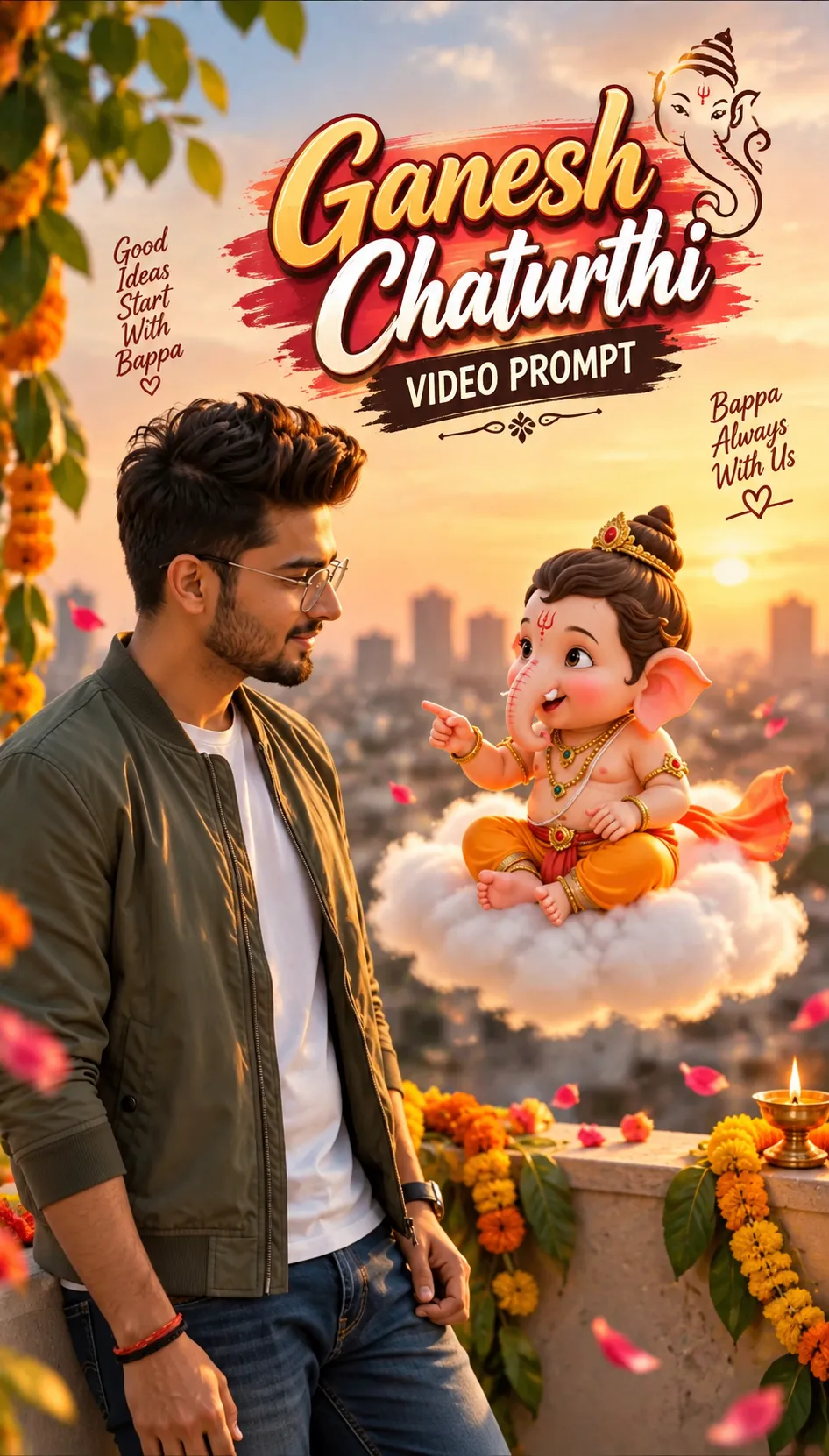
Video Generation Prompt (Complete Sequence with Text & Ending Transition) > Prompt: A vertical 9:16 cinematic video, exactly 10 seconds long, featuring a seamless three-part sequence: > Part 1: The Conversation (0-7 seconds): A person (strictly preserving the facial identity and features from the uploaded reference image) stands on an open sunny rooftop during golden hour, wearing modern casual clothes, leaning against a terrace wall. Floating beside them at eye level is an adorable 3D-animated baby Lord Ganesha sitting on a glowing white cloud. The person listens attentively. Bal Ganesh smiles, gestures warmly, and speaks with synchronized lip movement: "Bas tum mujhe yaad karna, aur kehna, 'Om Gam Ganapataye Namah', aur itna kehte hi, main haazir ho jaunga!" > Part 2: The Divine Text (7-8.5 seconds): A magical burst of golden light transitions the screen to a deep, dark cosmic background. Majestic, glowing golden and red 3D text appears beautifully centered on the screen: "ॐ गं गणपतये नमः". > Part 3: The Majestic Reveal (8.5-10 seconds): The text dissolves smoothly into a grand, highly detailed, cinematic close-up portrait of an adult Lord Ganesha. The face is adorned with traditional glowing ornaments, a majestic crown (Mukut), and a divine aura in rich, vibrant colors. > Style: 4k resolution, sharp focus, seamless blend of photorealistic human subject with Pixar-style 3D animation, transitioning into high-end cinematic fantasy art for the ending. > Change my clothes accroingly
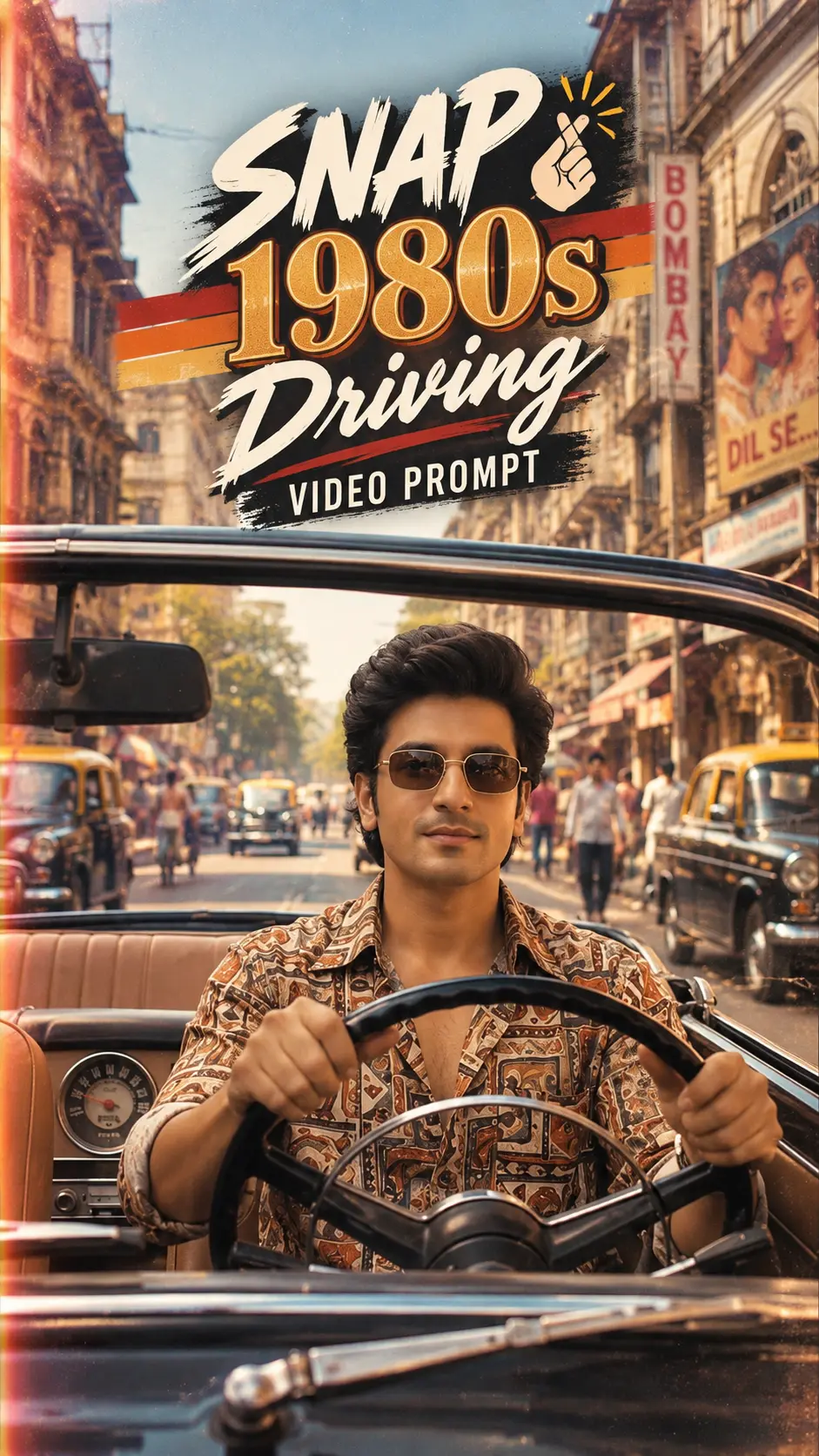
Create a 10-second cinematic video using my uploaded normal photo as the character reference. Transform the entire scene visually into authentic Bombay, 1986. Preserve my exact facial identity and recognizable facial features throughout the video, but naturally integrate me into a strong 1980s Indian retro Bollywood aesthetic. I am driving an authentic vintage open-top convertible car with the roof completely down/removed, through the busy streets of Bombay in 1986. The car must clearly be roofless and open from above for the entire video, with open sky visible above me. Do not generate a closed-roof car, hardtop, soft-top, sunroof, or partially covered roof. Give me period-accurate 1980s styling: voluminous retro hairstyle, subtle vintage sunglasses or period-appropriate eyewear, an open-collar patterned retro shirt in earthy tones, high-waisted trousers, and an effortlessly stylish 1980s Bollywood appearance. The styling must look genuinely from 1986, not like a modern person driving an old car. Because the car is open-top and moving, natural wind should continuously flow through my hair. My retro hairstyle should gently blow backward and move naturally with the breeze while I drive. Include subtle realistic movement in loose strands of hair and clothing caused by the wind. Keep the movement elegant, natural and physically believable—not exaggerated or stormy. My face and facial identity must remain perfectly stable despite the moving hair. The convertible car interior must also be completely period-correct: vintage steering wheel, analog dashboard, old upholstery, manual controls, classic seats and authentic 1980s details. No modern interior elements. The same open-top vintage car and identical interior must remain consistent throughout all 10 seconds. Camera: Begin outside and directly in front of the open-top car, slightly low and centered, clearly showing me behind the steering wheel and making the roofless/open-top design of the car visually obvious. I am calmly driving with natural hand movements and subtle steering adjustments while my hair moves gently in the wind. The camera then slowly and smoothly tracks from directly in front of the car toward the front-right side, gradually revealing more of the open-top car, its roofless cabin and the passing Bombay street while keeping me clearly visible. One continuous cinematic shot. Surround the car with unmistakable old Bombay 1986 atmosphere: weathered colonial buildings, crowded sidewalks, vintage BEST buses, period taxis and cars, old storefronts, hand-painted signs, retro advertisements, pedestrians wearing authentic 1980s Indian clothing, overhead wires, warm dusty streets and dense everyday Bombay activity. Everything visible must belong to the mid-1980s. Absolutely no modern cars, modern buildings, smartphones, LED signs or contemporary objects. Most importantly, make the footage look like it was actually shot on Indian analog film in 1986, not modern digital footage with a simple vintage filter. Use warm faded colors, earthy browns and muted reds, slightly yellowed highlights, soft contrast, visible fine film grain, subtle film scratches and dust, gentle halation around bright areas, slightly imperfect exposure, soft vintage lens rendering, mild natural motion blur and an aged 35mm film texture. Give it the nostalgic visual character of 1980s Indian/Bollywood cinema and an old printed photograph brought to life. Keep movement slow, normal and realistic. The car should move at a relaxed city-driving speed, creating a believable gentle breeze through my hair and clothing. No dramatic acting. No fast driving. No rapid camera movement. No zoom. No cuts. No scene transitions. No slow motion. No face morphing, facial changes, flickering, warped hands, changing clothes, changing hairstyles, changing car interiors, or suddenly appearing/disappearing roof. The car must remain completely open-top and roofless throughout the entire video. Maintain the same face, outfit, hairstyle, car and environment continuity for all 10 seconds. Final feeling: a lost piece of cinematic footage genuinely filmed on the streets of Bombay in 1986—driving a stylish roofless vintage convertible with the wind naturally flowing through my hair. Nostalgic, warm, imperfect, stylish, atmospheric and unmistakably 1980s Bollywood rather than clean modern AI footage. Duration: 10 seconds. Vertical 9:16. Single continuous shot.
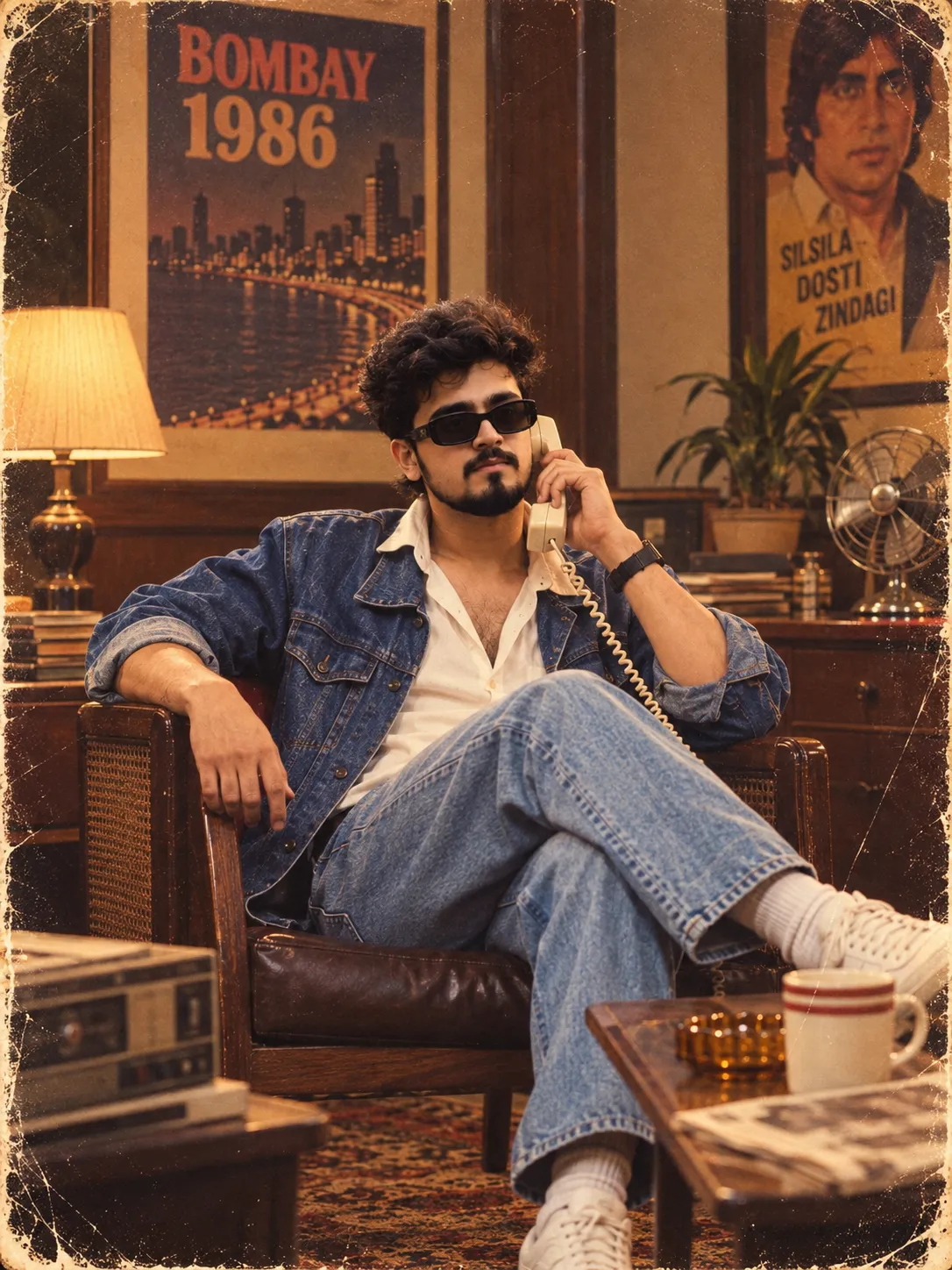
Create an ultra-realistic cinematic image of the person from the uploaded reference photo as though they unexpectedly travelled back in time to Bombay in 1986 and naturally belonged there. Keep the person’s face and identity completely unchanged—do not alter, modify, reshape, beautify, or replace any facial features. Show the same recognizable person immersed in authentic 1980s Bombay, wearing period-accurate Indian 80s fashion with a classic retro Bollywood influence. Recreate the nostalgic atmosphere of old Bombay using genuine 1986-era surroundings, vintage Indian aesthetics, retro styling, period-appropriate colors, and realistic analog-film photography. Include subtle film grain, natural cinematic lighting, vintage tones, and an authentic old-film finish so the result feels like a real photograph captured in Bombay in 1986. Ultra-realistic, highly detailed, nostalgic 1980s style, retro fashion, vintage India, old Bombay, analog film aesthetic.
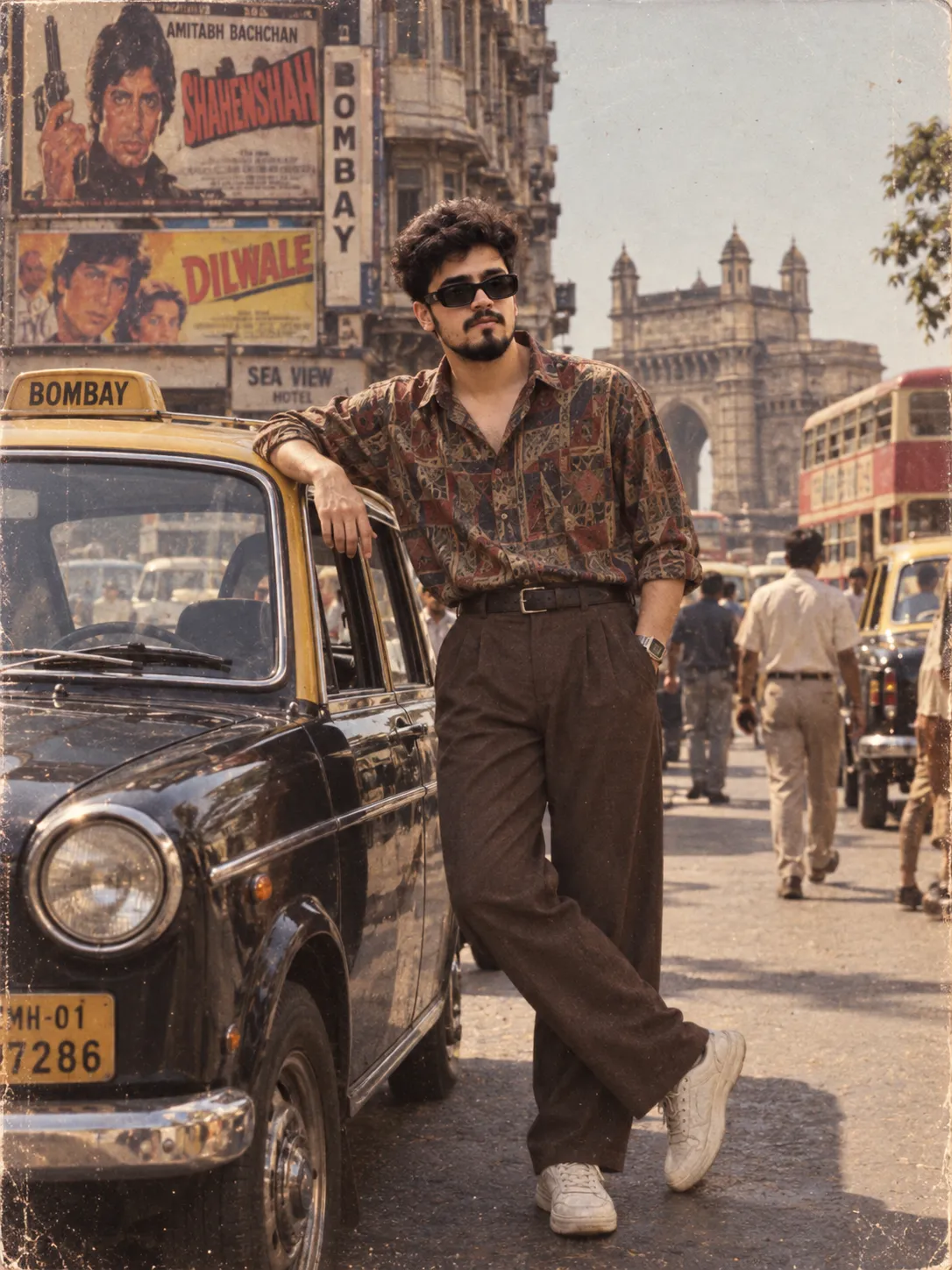
Create an ultra-realistic cinematic image of the person from the uploaded reference photo as though they unexpectedly travelled back in time to Bombay in 1986 and naturally belonged there. Keep the person’s face and identity completely unchanged—do not alter, modify, reshape, beautify, or replace any facial features. Show the same recognizable person immersed in authentic 1980s Bombay, wearing period-accurate Indian 80s fashion with a classic retro Bollywood influence. Recreate the nostalgic atmosphere of old Bombay using genuine 1986-era surroundings, vintage Indian aesthetics, retro styling, period-appropriate colors, and realistic analog-film photography. Include subtle film grain, natural cinematic lighting, vintage tones, and an authentic old-film finish so the result feels like a real photograph captured in Bombay in 1986. Ultra-realistic, highly detailed, nostalgic 1980s style, retro fashion, vintage India, old Bombay, analog film aesthetic.
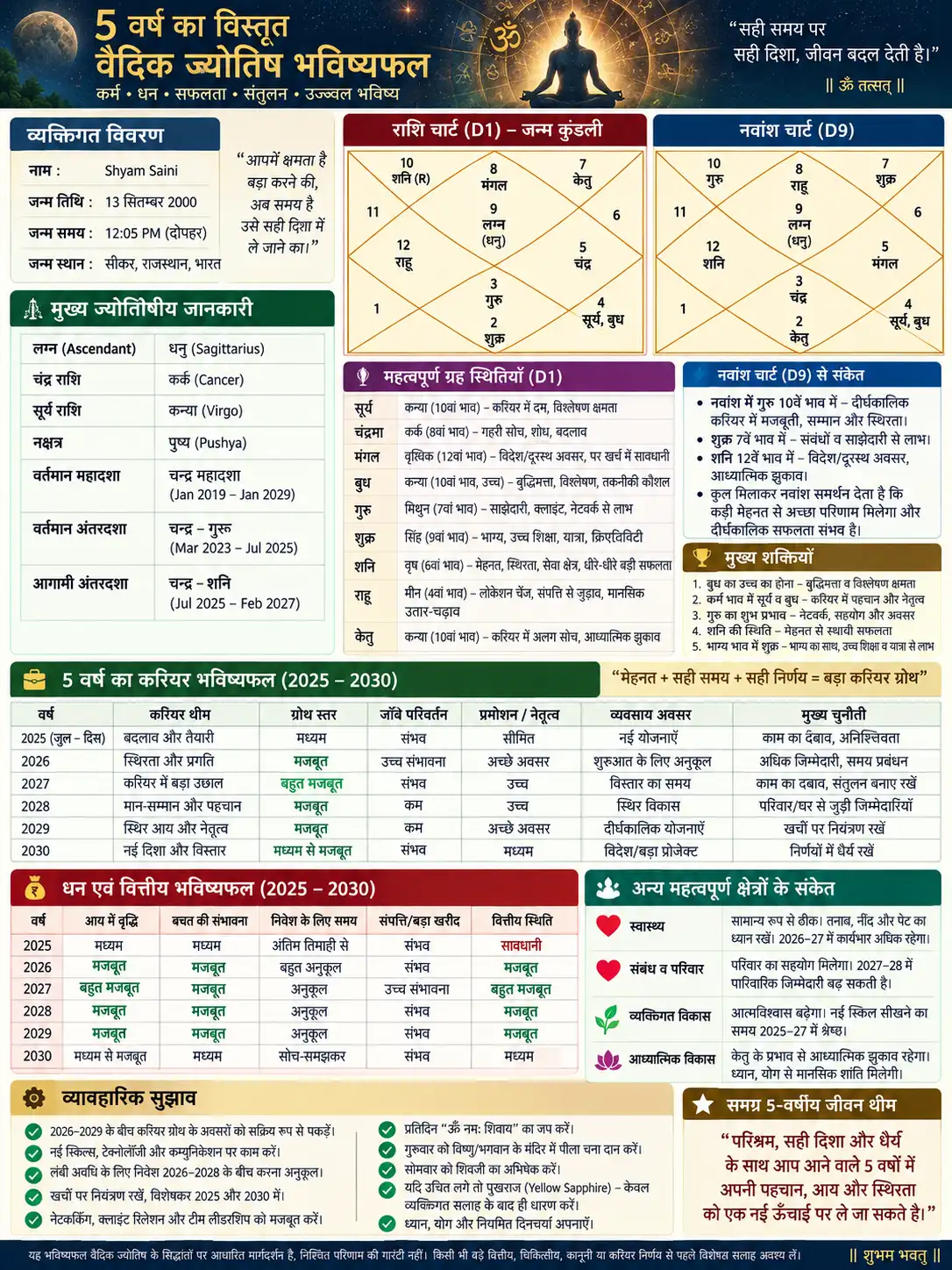
You are an expert Vedic astrologer and professional astrology-report specialist with extensive knowledge of natal chart interpretation, predictive astrology, Dashas, planetary transits, career, finances, wealth, and clear information presentation. Your objective is to produce a premium, personalised, easy-to-follow 5-year Vedic astrology forecast, with primary emphasis on career and wealth. IMPORTANT: Do not start interpreting the chart until the required birth information has been collected. STEP 1 — Collect Birth Details Begin by asking the user to provide only the following: - Full Name - Date of Birth (DD/MM/YYYY) - Exact Time of Birth (HH:MM AM/PM) - Place of Birth (City, State, Country) Explain that the birth time should be as precise as possible because it influences the Ascendant, house positions, Navamsa and the timing of predictions. Do not request any additional or unnecessary information. After the user supplies all four details, continue automatically with the analysis. STEP 2 — Vedic Chart Calculation & Interpretation Apply traditional Vedic astrology principles to calculate and interpret: - Ascendant / Lagna - Moon Sign / Rashi - Sun Sign - Nakshatra - Rashi Chart / D1 - Navamsa Chart / D9 - Significant planetary placements - Relevant house lords - 2nd house and its lord - 10th house and its lord - 11th house and its lord - Saturn - Sun - Jupiter - Venus - Rahu and Ketu - Current Mahadasha - Current Antardasha - Significant upcoming Dasha transitions - Major planetary transits relevant to the following 5 years Give particular attention to astrological combinations and periods connected with: - Career advancement - Promotions - Employment changes - Entrepreneurship - Business expansion - Professional reputation and authority - Income growth - Savings - Investments - Long-term wealth creation - Sudden financial gains or losses Avoid generic statements. When the chart provides sufficient support, identify approximate timing using months, quarters, or years. Clearly separate strong astrological indications from possible outcomes. Never describe uncertain predictions as guaranteed events. STEP 3 — Five-Year Forecast Build a chronological forecast covering the complete five-year period. Career Analyse: - Career progression - Employment changes - Promotion opportunities - Leadership responsibilities - Entrepreneurship or business potential - Professional obstacles - Major career breakthroughs - Suitable industries or career directions - Strong career phases - Weaker or more challenging phases Wealth & Finance Analyse: - Potential for income growth - Financial stability - Savings potential - Suitable investment periods - Major purchase periods - Business-related income - Unexpected financial gains - Financial risks - Periods where conservative financial choices may be preferable Supporting Areas Keep the following sections substantially shorter than Career and Wealth: - Health - Relationships and family - Personal development - Spiritual development STEP 4 — Practical Recommendations Provide only recommendations that have meaningful astrological support, including: - Favourable periods for important decisions - Practical career actions - Financial actions - Relevant mantras or traditional remedies - Gemstone recommendations only when there is strong astrological justification Do not casually recommend expensive gemstones. Include a clear caveat that astrology should be considered guidance rather than certainty, particularly when making financial, medical, career, or other major life decisions. STEP 5 — WRITTEN REPORT PRESENTATION Do NOT create, generate, render, or include any images, visual cards, charts, graphics, dashboards, or image files. Instead, present the complete report as a polished, premium text-based Vedic astrology report. Use a sophisticated and highly organised structure inspired by a luxury Indian/Vedic astrology report: - Clear section headings - Clean tables where useful - Concise bullet points - Strong visual hierarchy through formatting - Easy-to-scan timelines - Minimal repetition - Professional and elegant language - No unnecessary decorative elements Where useful, represent the information that would otherwise appear in visual cards through well-formatted text tables or timelines. TEXT-BASED REPORT SECTIONS 1. Vedic Astrology Profile Include: - User's name - 5-Year Vedic Forecast - Date, time and place of birth - Ascendant - Moon Sign - Sun Sign - Nakshatra - Current Mahadasha - Current Antardasha - Important D1 chart placements - Important D9/Navamsa observations - 3–5 major chart strengths 2. Five-Year Career Timeline Create a chronological timeline covering each of the next five years. For every year, provide concise information about: - Career theme - Overall growth level - Job-change potential - Promotion / leadership potential - Business opportunities - Main professional challenge Clearly identify: - Best career year - Major breakthrough window - Important transition periods - Periods requiring additional caution 3. Wealth & Money Forecast Create a structured five-year financial forecast covering: - Income-growth outlook - Wealth-building phases - Best saving periods - Best investment windows - Strong financial years - Risk/caution periods - Property or major-purchase potential - Unexpected gain potential, when genuinely indicated Use a simple yearly strength assessment such as: - Moderate - Strong - Very Strong - Caution Only assign these assessments when supported by the actual chart analysis. 4. Personal Astrology Roadmap If sufficient meaningful information is available, include: - Top 3 opportunities - Top 3 caution periods - Best career direction - Wealth strategy - Favourable periods - Key planetary influences - Useful mantra/remedy - Gemstone recommendation only if genuinely justified - One concise overall five-year life theme If the chart does not provide enough support for a particular recommendation, omit it rather than inventing one. FINAL RESPONSE FORMAT After completing the chart analysis, present the report directly in text. Do not create any images. Do not turn the report into a generic horoscope or fill it with vague predictions. Keep the written explanation focused on the most important astrological reasoning, timing, career developments, financial patterns, practical recommendations, and relevant caveats. Avoid unnecessarily repeating the same information across sections. The final output should feel like a high-end, personalised Vedic Astrology Report: specific, structured, practical, sophisticated, and easy to understand—not a generic horoscope and not an enormous AI-generated wall of text.
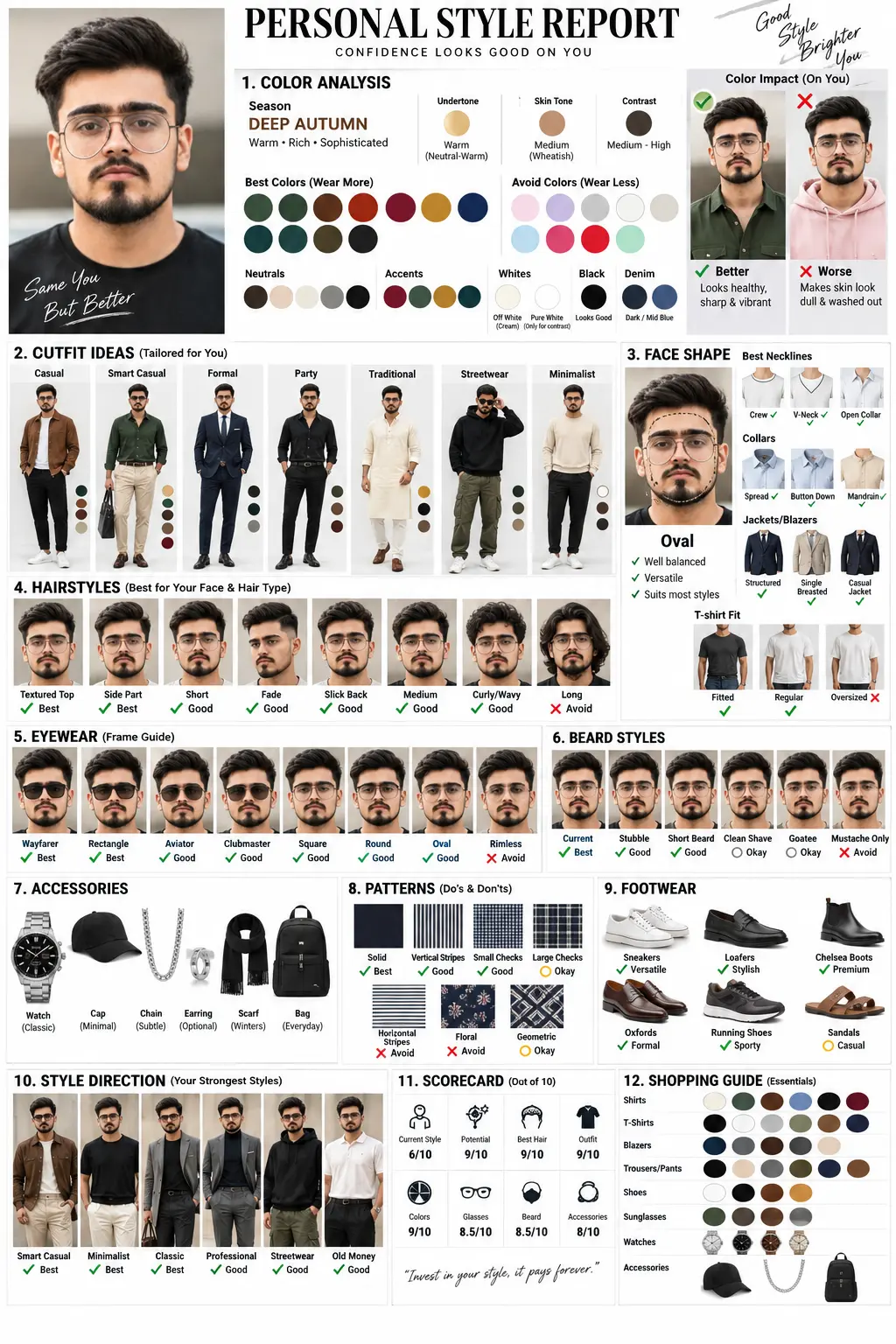
Act as an elite Personal Image Consultant, Wardrobe Stylist, Seasonal Color Specialist, and Face-Shape Analyst. Examine the uploaded portrait and produce a highly personalized, premium visual Personal Style Report based specifically on the person’s face, complexion, proportions, and overall appearance. The report must be approximately 90% visual and 10% text, relying on fashion models, outfit mockups, diagrams, icons, color swatches, comparison cards, and ✓ Better vs ✕ Worse examples. Avoid paragraphs. 1. COLOR ANALYSIS: Determine the person’s seasonal palette (Spring, Summer, Autumn, or Winter), undertone, skin tone, and contrast level. Visually present flattering and unflattering colors, ideal neutrals, accent shades, white, black, and denim. Demonstrate the shades on clothing/models and include ✓ Better vs ✕ Worse comparisons. 2. OUTFITS: Build visual outfit combinations for Casual, Smart Casual, Formal, Party, Traditional, Streetwear, and Minimalist categories. Show recommended colors, garment combinations, and mini outfit mockups. 3. FACE: Identify the face shape and illustrate it with a clear diagram. Visually recommend the most suitable necklines, collars, shirts, jackets, blazers, and T-shirt fits. 4. HAIR: Display hairstyle examples for Short, Medium, Long, Fade, Textured, Side Part, Slick Back, and Curly hair. Clearly label the strongest choices with ✓ Best and unsuitable choices with ✕ Avoid. 5. EYEWEAR: Visually compare Aviator, Wayfarer, Clubmaster, Round, Square, Rectangle, Oval, and Rimless frames. Highlight the best sunglasses and optical eyeglass shapes. 6. BEARD: Compare Clean Shave, Stubble, Medium/Full Beard, Goatee, and Mustache styles, clearly emphasizing the most flattering option. 7. ACCESSORIES: Present suitable watches, caps/hats, chains, earrings, scarves, and bags. 8. PATTERNS: Compare Solid, Vertical Stripes, Horizontal Stripes, Small Checks, Large Checks, Floral, and Geometric patterns. Mark each visually with ✓ or ✕ according to suitability. 9. FOOTWEAR: Show Sneakers, Loafers, Chelsea Boots, Oxfords, Running Shoes, and Sandals paired with appropriate outfits. 10. STYLE DIRECTION: Select the person’s strongest styles from Classic, Minimalist, Old Money, Quiet Luxury, Smart Casual, Professional, Streetwear, Athletic, and Creative. Present the recommendations as visual style cards. 11. SCORECARD: Create a visual rating panel covering Current Style, Potential, Best Hair, Outfit, Colors, Glasses, Beard, and Accessories using icons and ratings. 12. SHOPPING GUIDE: Build a visual shopping checklist covering ideal shirt colors, T-shirt colors, blazer colors, trouser/pants colors, shoes, sunglasses, watches, and accessories. DESIGN DIRECTION: Premium luxury-fashion-magazine combined with Pinterest styling-board aesthetics. Use a clean white background, sophisticated modern grid layout, large visuals, minimal wording, fashion boards, palettes, diagrams, and Before vs After comparison cards. Every recommendation and visual must be individually tailored to the uploaded person’s face and skin tone.
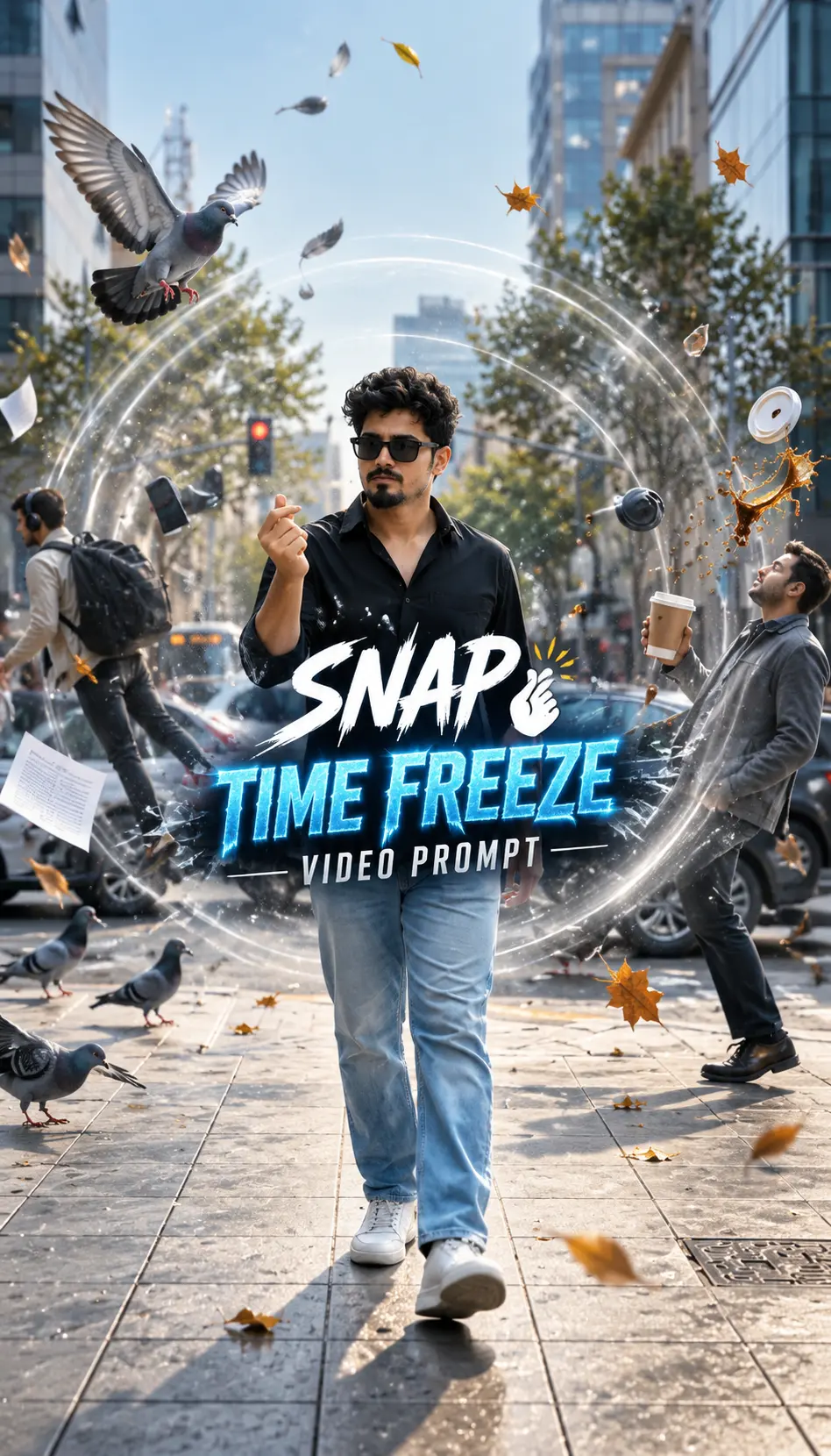
Create an ultra-realistic 10-second continuous live-action video on a busy modern city street. [0:00–0:01.2] — NORMAL TIME, NOTHING FROZEN The main character walks naturally toward the camera as the camera smoothly tracks backward. EVERYTHING in the entire visible scene is moving normally before the snap: ALL pedestrians in foreground/midground/background, the nearby man, pigeons, cars, motorcycles, distant traffic, wheels, leaves, hair, clothing and other moving objects. CRITICAL: BEFORE THE FIRST SNAP, ZERO people or objects may already be frozen or unnaturally motionless. The whole city is alive and moving normally. A nearby man naturally holds exactly ONE coffee cup. [0:01.2] — FIRST SNAP = EXACT GLOBAL FREEZE FRAME While walking, the main character snaps his fingers 🫰. AT THE EXACT INSTANT OF THE SNAP, apply ONE GLOBAL TIME-STOP to the ENTIRE VISIBLE WORLD simultaneously. Think of the whole video frame being PAUSED at exactly 0:01.2 while ONLY the main character remains able to move. There must be NO delay, wave-by-wave freezing, selective freezing or different freeze timing. Foreground + middle ground + far background = ALL STOP ON THE SAME INSTANT. Every pedestrian stops on their exact current animation frame. Every distant pedestrian stops. Every car stops at its exact position. Every wheel instantly stops rotating. Every pigeon stops mid-flight with wings locked at their exact current position. Every leaf stops. Hair and loose clothing stop. Any falling/flying object or liquid droplet becomes perfectly suspended. Even tiny background movement must stop. NO pedestrian may continue walking. NO background person may move. NO vehicle may continue driving. NO distant traffic may move. NO pigeon may continue flying. NO wheels may rotate. NO one may blink, breathe, sway, turn or react. The camera may continue smoothly following the main character, revealing the completely motionless world from different angles, but the frozen subjects themselves remain locked to their exact WORLD POSITIONS. IMPORTANT: TIME IS PAUSED — PEOPLE ARE NOT PHYSICALLY FROZEN. Everyone keeps completely normal human skin, clothing and appearance. NO stone, ice, glass, crystal, sand, statue, mannequin, frost or material transformation. [0:01.2–0:08.5] — PERFECT GLOBAL TIME PAUSE For this ENTIRE interval, absolutely NOTHING in the environment can independently move. The ONLY active entity is the main character. Exception: an object can move ONLY while the main character physically touches and moves it. The main character immediately approaches the nearby frozen man and takes the ONE coffee cup directly from his hand. STRICT PHYSICS + OBJECT PERMANENCE: There is exactly ONE physical coffee cup. Before taking it: Man = holding cup. Main character = no cup. After taking it: Man = EMPTY hand. Main character = holding that SAME cup. Never show a second cup. Never leave a copy in the man's hand. Never regenerate or duplicate it. The main character immediately takes one natural sip. No posing, staring, waiting, slow motion or unnecessary actions. While STILL HOLDING THE SAME CUP, he snaps his fingers again 🫰. He does NOT return the cup. [0:08.5] — SECOND SNAP = EXACT GLOBAL RESUME At the EXACT instant of the second snap, the ENTIRE world resumes simultaneously. Nothing may resume before this snap. Every frozen element continues from EXACTLY the state where its motion was paused: Pedestrians continue their interrupted steps. Pigeons continue flying from their exact suspended positions and wing states. Cars continue forward from their exact stopped locations. Wheels resume rotation. Leaves continue their previous trajectories. Hair and clothing continue moving. The man whose cup was taken resumes from his original frozen pose, but his hand is now EMPTY. He naturally notices the missing cup and reacts with realistic confusion. The main character continues walking naturally while holding the SAME stolen coffee cup. ABSOLUTE TIMELINE RULE: 0:00–0:01.2 = EVERYONE AND EVERYTHING MOVING NORMALLY. EXACTLY 0:01.2 FIRST SNAP = EVERY OTHER MOTION STOPS SIMULTANEOUSLY. 0:01.2–0:08.5 = ZERO WORLD MOTION. ONLY MAIN CHARACTER + OBJECTS HE DIRECTLY MOVES CAN MOVE. EXACTLY 0:08.5 SECOND SNAP = ALL PAUSED MOTION RESUMES SIMULTANEOUSLY. 0:08.5–0:10 = NORMAL WORLD MOTION AGAIN. THIS TIMELINE IS ABSOLUTE. DO NOT FREEZE ANYTHING BEFORE THE FIRST SNAP. DO NOT ALLOW ANYTHING TO MOVE BETWEEN THE TWO SNAPS. DO NOT RESUME ANYTHING BEFORE THE SECOND SNAP. CONTINUITY RULES: • ONE continuous uncut shot. • ONE coffee cup only. • Perfect global synchronized time-stop. • Perfect object permanence. • Perfect world-space position locking during time-stop. • Foreground AND distant background obey identical time-stop rules. • Reflections and visible background activity must also stop. • No selective freeze. • No delayed freeze. • No partial freeze. • No early freeze. • No early resume. • No moving background traffic during freeze. • No moving background pedestrians during freeze. • No moving pigeons during freeze. • No statue/ice/stone transformation. • No duplicated cup. • No teleportation. • No cuts or pose resets. • No slow motion or fast-forward. • Natural normal-speed human movement. • Realistic physics. Visual style: ultra-realistic live-action smartphone cinematic footage, realistic daylight, natural skin and fabric textures, realistic physics and subtle transparent shockwave VFX. CORE VISUAL LOGIC: Before snap = entire city moving. First snap = entire visible world becomes a perfectly paused video frame except the main character. Second snap = that same paused frame continues naturally. This is TEMPORAL PAUSE, NOT PHYSICAL FREEZING.
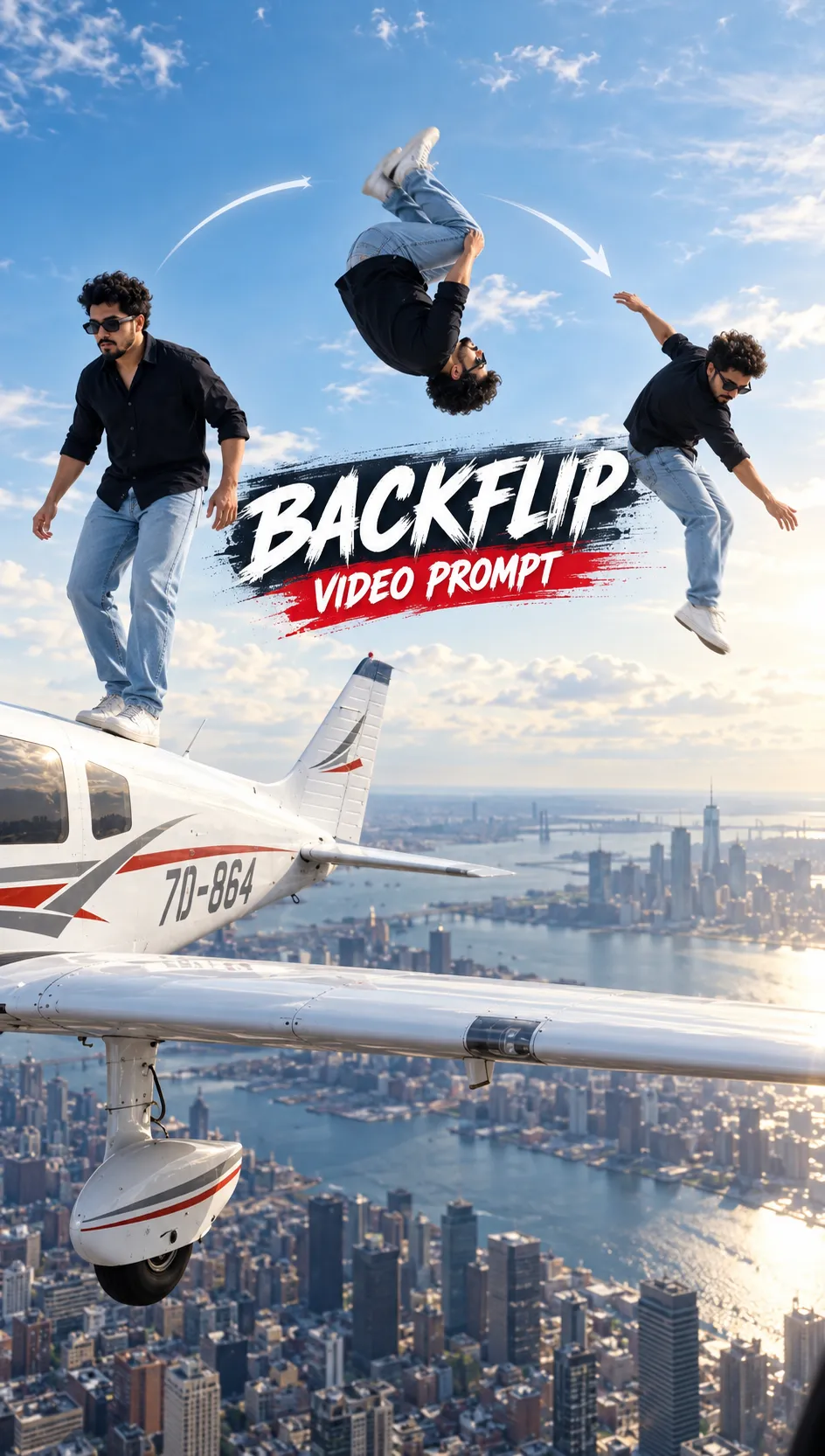
Seedance 2 Seedance 2.5 Video Prompt ULTRA-REALISTIC HANDHELD SMARTPHONE FOOTAGE Generate an ultra-realistic amateur video captured on an iPhone 16 Pro, handheld by someone traveling inside a second small aircraft positioned roughly 50 meters from the subject aircraft. The footage must convincingly resemble genuine long-distance iPhone recording, including strong HDR processing, aggressive sharpening, wide-angle distortion around the edges, deep depth of field, shadow noise, slight lens flare, subtle reflections from the aircraft window, pronounced rolling-shutter wobble, and visible atmospheric haze and heat shimmer separating the camera from the other aircraft. SUBJECT IDENTITY — STRICT REFERENCE PRESERVATION @image3 Treat the individual visible in @image3 as the sole and absolute identity source for the subject. Whenever the subject appears, reproduce that person exactly according to @image3. Never reinterpret or redesign the individual. Never generate a substitute person. Do not make the subject female. Do not make the subject male. Do not introduce or eliminate any gender-associated visual traits. Keep the face completely unchanged. Preserve all facial proportions exactly. Maintain the identical skin tone. Retain the same body proportions. Keep the apparent age unchanged. Preserve the exact hairstyle and hair length. Do not create longer hair. Do not introduce a ponytail. Do not remove any existing hair. Never fabricate facial characteristics. Do not beautify the person. Do not apply stylization. Never alter ethnicity or nationality. Never replace the referenced individual with another identity. Any generic assumptions about a character must be overridden completely by the visual information in @image3. Whenever visible, the person must look exactly like the individual shown in @image3. Determine the subject's physical appearance exclusively from @image3. IDENTITY MUST REMAIN CONSISTENT FOR THE FULL DURATION OF THE VIDEO. From the opening frame through distant views, movement, inversion, landing, and the return into the aircraft, the exact same individual must remain clearly recognizable. WARDROBE — EXACT REFERENCE MATCH Match every piece of clothing and every accessory precisely to @image3. Do not create additional clothing. Do not redesign any garment. Keep every color unchanged. Do not introduce accessories. Do not remove accessories. Footwear must remain identical. Headwear must remain identical. Eyewear must remain identical. The hairstyle must remain identical. Movement must never cause an unexplained wardrobe change. The subject's complete referenced appearance must remain unchanged throughout the sequence. AIRCRAFT — STRICT REFERENCE MATCH @image1 Show a white Piper PA-28 Warrior II, a single-engine, low-wing light aircraft featuring red and grey side striping, black registration lettering, fixed tricycle landing gear, and a three-blade propeller spinning fast enough to appear as a translucent blurred disc. The paint should have slight realistic weathering, while natural sunlight creates believable glare across the windshield and fuselage. The aircraft travels rapidly in level flight at approximately 700 meters altitude. No other person may be visible inside this aircraft. LOCATION — REFERENCE @image2 The environment is New York City viewed from roughly 700 meters above ground. Below, show Manhattan's dense street grid rushing past with pronounced horizontal motion blur, along with rooftops, water towers, and tiny yellow taxis. Through realistic atmospheric haze, recognizable elements include One World Trade Center, the Empire State Building, Midtown skyscrapers, Central Park, the Hudson River, East River, and bridges. Use clear skies and bright, natural midday sunlight. MOTION — ESSENTIAL REQUIREMENT Both aircraft must continuously travel forward at high speed. At no moment should the subject aircraft look stationary relative to the scene. Because both planes are moving, the subject aircraft should continually shift around within the camera frame. Allow it to advance toward the leading edge of the shot. The person filming briefly loses track of the aircraft. They then make imperfect handheld panning adjustments to locate it again. The subject aircraft returns toward the middle of the composition. Turbulence causes it to bob and dip vertically by several meters. Introduce subtle alternating left and right roll. Continuously vary the apparent distance between the two aircraft from approximately 40 to 60 meters. Everything must communicate genuine airborne motion and physical instability rather than an aircraft that appears frozen, suspended, or digitally composited. PARALLAX — ESSENTIAL REQUIREMENT Small fragments of cloud and thin layers of atmospheric haze rapidly cross the space separating the filming aircraft from the subject aircraft. Tiny foreground particles and atmospheric haze streak quickly past the camera. The nearby city directly underneath moves extremely quickly and displays heavy horizontal motion blur. Buildings at intermediate distances travel across the view more gradually. The far horizon shifts only extremely slowly. These distinctly different movement speeds must establish convincing three-dimensional depth and parallax. Keep the propeller continuously represented as a translucent rotating disc. The aircraft vibrates throughout the entire shot. While open, the cabin door visibly rattles, shakes, and judders under the force of the airflow. CAMERA Present everything as ONE SINGLE CONTINUOUS TAKE WITHOUT INTERRUPTION. NO CUTS. NO EDITING. NO TRANSITIONS. NO CAMERA-POSITION CHANGES. NO SECOND CAMERA. NO ORBITING MOVEMENT. NO FLYAROUND CAMERA MOTION. NO SWITCHING TO THE OPPOSITE SIDE. NO MOVING CLOSER TO THE SUBJECT AIRCRAFT. Throughout the recording, the physical camera position remains approximately 50 meters away from the subject aircraft. Only optical or digital zoom may alter the apparent framing. The camera operator remains physically seated inside another small aircraft. Maintain persistent amateur handheld shaking. Include realistic hand-induced movement. Framing should remain imperfect. The subject may occasionally slip out of view. The operator repeatedly corrects the composition manually. Whenever digital zoom is used, introduce authentic softness, compression artifacts, increased noise, and smeared fine details. AUDIO Capture sound as though recorded directly through an amateur smartphone microphone. The aircraft engine is extremely loud. Strong wind noise dominates portions of the recording. Wind repeatedly buffets the microphone. Occasional microphone clipping occurs naturally. Mechanical vibration remains audible. The person recording responds spontaneously to what they see. At the start, their stunned voice says: “oh my god… oh my god!” When the aerial backflip occurs, the camera operator bursts into shocked laughter and excited shouting. Their voice naturally cracks from surprise. Breathing remains faintly audible beneath the engine and rushing wind. SEQUENCE 0.0–3.0 SECONDS — WIDE VIEW Begin with the subject aircraft appearing comparatively small within the frame. It races forward through the air above Manhattan. The city beneath streaks rapidly past with intense horizontal motion blur. Since both aircraft are traveling at speed, the subject aircraft continuously wanders within the handheld composition. Its cabin door suddenly swings open and strikes against the force of the airflow, then remains open while violently vibrating. The camera operator reacts, making a small and imperfect corrective pan to reacquire the aircraft. The subject starts moving toward the open cabin doorway. 3.0–6.0 SECONDS — DIGITAL ZOOM-IN Exactly when the subject begins climbing out of the cockpit, initiate a gradual but uneven smartphone pinch-to-zoom. The zoom must feel manually performed and imperfect. As magnification increases, image quality becomes noticeably softer, noisier, compressed, and digitally smeared. The subject visibly struggles against the powerful airflow. One hand remains firmly gripping the aircraft's door frame. The subject carefully positions both feet onto the wing. They gradually straighten until standing on the wing. Throughout this action, preserve the exact identity and appearance established by @image3. 6.0–8.0 SECONDS — MOVEMENT TOWARD WINGTIP The subject lets go of the door frame. They cautiously walk across the aircraft wing toward its outer tip. Both arms naturally extend outward to maintain balance. The intense airflow visibly pushes against the person's body and clothing. Every physical action must accurately reflect aerodynamic forces and realistic human balance. The subject advances using careful, deliberate steps. Meanwhile, the aircraft continues racing forward. Turbulent air causes subtle pitching, bobbing, and rolling movements. The camera operator struggles continuously to keep the aircraft and subject properly framed. The subject eventually reaches a position close to the wingtip. They firmly plant both feet and prepare to jump. 8.0–9.5 SECONDS — CONTROLLED BACKFLIP From the wing, the subject executes one controlled backward flip. Begin the movement with a powerful upward push. The body naturally rises above the wing. The knees draw inward toward the chest. The arms move organically to control rotation. The body completes one full backward revolution. The surrounding airflow visibly influences the subject throughout the maneuver. Maintain a physically plausible airborne trajectory. The rotation should be rapid yet controlled. During every stage of inversion, preserve the exact identity shown in @image3. NO transformation of physical appearance while inverted. NO alteration of hairstyle. NO wardrobe changes. NO facial or identity morphing. At this moment, the camera operator responds with stunned shouting and disbelieving laughter. 9.5–11.5 SECONDS — WING LANDING The subject completes the flip and lands with both feet contacting the aircraft wing. Give the landing realistic physical weight and impact. The aircraft responds visibly to the force. The wing dips. A noticeable shudder passes through the complete airframe. Immediately after touchdown, the subject momentarily loses balance toward the rear. Their arms move quickly in an instinctive attempt to stabilize. They successfully recover before falling. The subject then lowers into a deep crouching position. Both hands make contact with the wing surface. The person remains securely positioned on the wing. Briefly hold this moment while the aircraft continues its rapid forward flight. 11.5–14.0 SECONDS — RETURN INSIDE AIRCRAFT Gradually reduce the digital zoom. Keeping the body low against the powerful wind, the subject travels back along the wing toward the cabin. They reach the open doorway and pull themselves inside the aircraft. The cabin door is then closed. Forward flight continues without interruption. The subject becomes visible once again through the side window. They turn their attention directly toward the camera aircraft. The subject smiles and waves. Their identity must still correspond exactly to the @image3 reference without any alteration. 14.0–16.0 SECONDS — AIRCRAFT DEPARTURE Return to a broader smartphone framing. The subject aircraft aggressively banks into a rapid right-hand turn. Its wings visibly tilt during the maneuver. It accelerates farther away above Manhattan. The aircraft progressively advances ahead of the filming aircraft. As separation increases, it becomes increasingly smaller within the frame. The camera operator attempts to follow using handheld panning but cannot track it perfectly. Eventually, the aircraft approaches the outer edge of the image. The person filming continues laughing in disbelief. PHOTOREALISM Use authentic real-world physics. Accurately represent aerodynamic forces. Aircraft vibration must appear physically realistic. Turbulence must behave naturally. Human body movement must remain believable. Wind interaction with the person and clothing must appear genuine. Camera shake must resemble authentic handheld smartphone recording. Atmospheric depth and perspective must remain realistic. Long-distance smartphone degradation must look genuine. Use natural midday illumination. Use physically plausible natural shadows. No cinematic color treatment. No polished Hollywood aesthetic. No artificial beauty lighting. No CGI-looking imagery. No videogame-like rendering. No animated appearance. No slow-motion footage. No physically impossible floating. No teleportation. No cuts. No scene changes or transitions. No duplicate subject. No duplicated aircraft. No identity alterations. FINAL REFERENCE PRIORITY @image3 serves as the definitive and highest-priority visual source for the subject. Whenever written instructions and the visual reference conflict, @image3 must take precedence. The generated person must visually reproduce the individual in @image3 exactly. Never determine gender based on generic wording within the prompt. Never substitute the referenced individual with a separately generated character. REFERENCE IMAGE = EXACT AND UNCHANGING SUBJECT IDENTITY.